



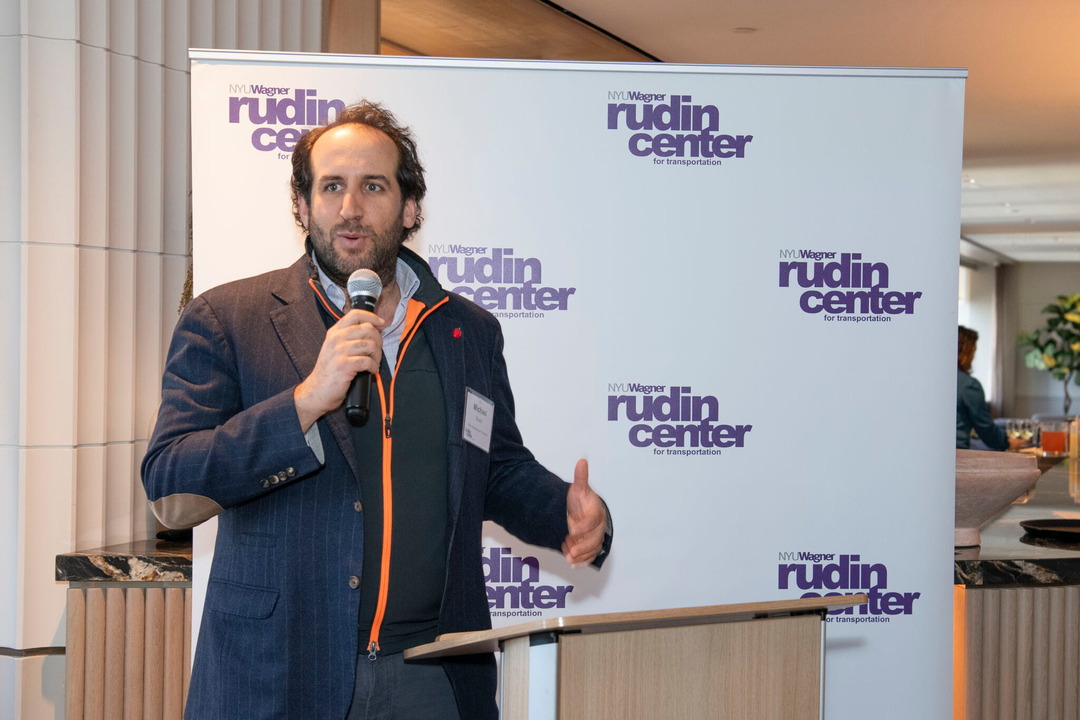
Four Generations, 100 Years, and 13 Million Square Feet: Michael Rudin’s Family Business
The company Michael Rudin helps lead is extraordinary. It’s more than 100 years old. There are dozens of countries that are younger than that.
It’s a family business, so personal and professional ties are inextricable, and every asset is in New York City—thus subject to all the local, global, political, and economic events that have shaped and sometimes disrupted New York since 1925.
That’s a lot to navigate, but as co-CEO of one of the largest privately owned real estate firms in New York, Michael Rudin seems to manage it all very calmly.
He talked about running his family’s business with Camber Creek General Partner, Jeffrey Berman.
Lionel Foster: All right, Michael, welcome to Catalyst. I’ll let Jeff kick it off.
Jeffrey Berman: Yeah. Mike, it’s been a minute.
Let’s talk about New York City for a second.
Obviously, your family has been committed to real estate in the city for more than a hundred years, and I don’t think it’s hyperbolic to say that your family sits with a handful of others in really building what the city became. And I’m using that past tense intentionally.
What do you think about that legacy? How do you think about that legacy through the lens of the type of opportunity that you and Samantha, your Co-CEO, look at now?
What is the most stark difference between what it was when your forebearers started the business versus what you’re dealing with now?
I know that’s a lot, but feel free to take your time.
Michael Rudin: Yeah, well, thank you.
I’ll start with the legacy, which is hugely important for myself, for my sister, for the rest of the family members, and I think really most people in the company.
It’s a big part of why people come to the company and choose to work for us, and in most cases, work for significant portions of their careers.
That is because of the impact that our company and my family has had in New York City.
The importance of that, and how meaningful that is to most people who know this business, know this industry, and understand the ups and downs of the city and its history—and want to play a role in continuing that legacy and impact that companies like mine can have in shaping the direction of a place like New York City.
So it’s ever-present and something we think about constantly, if not daily.
And I think what has changed—what my ancestors would think about the world we’re in now—obviously a lot has changed.
Jeffrey Berman: You don’t say, “a lot?”
Michael Rudin: Yeah, understatement of the year.
But looking at our industry, the competitiveness has changed—from the standpoint of how many stakeholders are part of the process, and how competitive our city has become from the perspective of people, companies, and institutions wanting to invest here.
In 1925, when my great-grandfather started, the pool of capital or investors was probably much smaller. It was a more local investment culture.
Now it’s global.
Access to capital, and how capital views New York City—as one of, if not the most attractive places to invest in real estate—has shifted.
That change probably happened over the last 50 years.
The first 50 years of our company’s history were much more local, and then over time it became national and ultimately global.
Jeffrey Berman: Are you talking about the investor base?
Michael Rudin: Yeah.
Jeffrey Berman: So just providing insight into how the family operates: are you primarily using your own equity, or are you raising funds deal by deal?
How has that changed over the years as New York City has become a global beacon for real estate investment?
Michael Rudin: We have always, historically, taken the approach of self-capitalizing. But starting in the late 1960s—so over 50 years ago—we established our first partnership with an entity outside the family.
Since then, we’ve done fewer than 10, even fewer than seven, one-off partnerships across our portfolio.
In the last 25 years, we’ve contemplated alternative ways of capitalizing deals, and those partnerships have increased in frequency.
Since the turn of the century, we haven’t self-capitalized a project. Everything has been done with a partner. We’ve never been less than 30% of a deal, but looking forward, the types of projects we pursue now require such substantial capital that we need partners.
That’s another big change: the scope and magnitude of projects today would surprise my great-grandfather in terms of cost. Because we reinvest heavily in our existing portfolio and operate with low leverage, we don’t have a lot of dry powder for new deals of scale. We want to have skin in the game and be true partners, so we’re more selective.
But to continue growing, which is a primary goal for my sister and me, we need to explore alternative ways of capitalizing: funds, deal-by-deal, or strategic platforms. We discuss these regularly, but nothing has been executed in a material way yet beyond conversations with institutions, family offices, and other investors.
Jeffrey Berman: Certainly a slight tangent, but related: many New York listeners will know who you are, but for those who don’t, can you give a sense of scale? Square footage, apartments under management: what does a legacy business look like today versus a hundred years ago?
Michael Rudin: Of course.
We are just over 13 million square feet of property, all in New York City. We have about 2,400 apartments across 18 buildings. We own what we manage, and we manage what we own.
On the commercial side, we have just under 9 million square feet across 13 buildings. Everything we do is in-house.
We started with a six-story multifamily building in the Bronx in 1925 and have grown to what we are today. We’re slightly smaller than pre-pandemic. We’ve sold a couple of assets in the last six or seven years, deviating from a long-standing family motto of never selling.
We’re now thinking more strategically about growth and where to allocate capital while continuing to reinvest in the legacy portfolio. Both are important and require capital.
Jeffrey Berman: So about 9 million square feet of office and 4 million residential.
That’s a lot for a private family, even if it’s small relative to New York overall.
Yet your family and others still have outsized influence on real estate politics. Has that changed?
Michael Rudin: The impact on politics and policy has shifted significantly. There are many more stakeholders at the table now. But real estate has always played a large role in shaping policy.
From the 1960s and 70s onward, leaders in the industry, including my family, have been involved in helping ensure New York remains a place where people and companies want to be.
That role continues, but there are far more voices and groups involved now than ever before.
Jeffrey Berman: Well, let me ask you. And this is a tangent on the tangent—and I promise we’ll get back to the beginning, dear listener—but would you consider Rudin an institutional business?
And the reason I’m asking is, to me, it certainly is institutional. At the same time, you have flexibility, because you’re a private family with very low leverage. You can chart your own path in a way that, let’s say, Blackstone, as large as they are, can’t really.
So how would you qualify Rudin and businesses like yours? And then looking at it through the lens of the power brokers in New York City—as the influence has shifted, as you said, with more institutional players and more stakeholders—would you say it has shifted toward a more institutional, private equity–backed consortium, or do the legacy family businesses like yours still maintain outsized influence? How do you think that plays out?
Michael Rudin: I think it’s a little bit of both.
We still hold influence, but we are, I’d say, quasi-institutional. To your point, we are an institution in the sense of a business that has existed, thrived, and been around for a century. But from the standpoint of an institutional investor, we are not—we are a family, more like a family office.
We have flexibility and the ability to pivot or shift our focus more nimbly than institutional investors. But those institutional investors have realized the importance of civic engagement wherever they invest and operate.
Because of that, most have taken a much more hands-on approach in terms of being at the table and helping shape policy and how cities operate.
So it’s a mix of both.
Jeffrey Berman: Interesting.
Do you feel like the real estate industry has a good relationship with City Hall? And is it more institutions leading the charge, or legacy family businesses and smaller stakeholders? How is that playing out?
Michael Rudin: I think it’s everyone trying to be involved.
With organizations like REBNY, ABNY, and others, it’s a broad coalition of family-run and institutional businesses engaged in ensuring New York City’s viability.
As for the relationship with the current administration, it’s about open dialogue. Two and a half months in, that dialogue is open. Where it goes is too soon to tell.
Our view is that our business is not mobile. We can’t just decide to move. We could sell, but even that isn’t simple.
So we take the approach of working with whoever is in leadership—city, state, or federal.
Jeffrey Berman: You have to work with what’s there.
Michael Rudin: Exactly. We want to be receptive, collaborative, and engaged. It’s a two-way street—we can’t force outcomes.
We want to be commercial, collaborative, collegial, and roll up our sleeves.
We’re not always going to agree, even with leaders we align with. That’s just reality. Compromise is part of it, and things won’t always go your way.
But hopefully interests are aligned so that New York City continues moving in a positive direction.
Jeffrey Berman: Your business is impacted by how people perceive New York—safety, security, prosperity.
What was the toughest period to navigate, and when did the company most benefit from being New York–centric?
Michael Rudin: In my lifetime, I’ve experienced three very challenging moments—9/11, the financial crisis, and COVID. They were all very different, but all incredibly challenging, so it’s hard to rank them.
From a working perspective, COVID was the most challenging for me personally because of my role at the time. It was a global event that affected everyone personally and professionally.
We came out stronger in many ways, but it was a defining experience.
We also experienced something equally challenging with the mass shooting in one of our buildings last year.
Lionel Foster: The shooting Michael is referring to took place in July 2025. A gunman entered one of his company’s buildings and opened fire. Five people died, including a Rudin Management employee.
Michael Rudin: That was an entirely different kind of challenge, something we never imagined.
It’s hard to compare these events, but they were all incredibly impactful in our company’s and my personal journey.
Jeffrey Berman: Those experiences—some global, some local—must feel different in a family business versus an institutional one.
Specifically with the shooting, how did you handle it, balancing the human and emotional side with the responsibilities of running the business?
Michael Rudin: Yes.
Six weeks before, we had celebrated our centennial in the same lobby. We went from the highest of highs to the lowest of lows.
With other crises, you can rely on history or past experience. With something like that, there is none.
It’s unimaginable.
So yes, it was the greatest challenge we’ve faced in our tenure as Co-CEOs.
Jeffrey Berman: And how much did you lean on your dad? Obviously, he has a longer operating history, and that’s where the benefit of being part of a legacy family business comes into play. Is that something where you conferred with the elders of the business, or was it, “This is our ship—sink or swim—we’re figuring it out”?
Michael Rudin: No, as with everything, the good news is that both my dad and my cousin are still very much around, engaged day to day. So it was both. We were all leaning on each other.
To my earlier point, nobody could say, “I’ve been through something like this before, and here’s how you handle it,” because in our world, in New York City, there haven’t really been other mass shootings. So you couldn’t rely on past experience.
At the same time, my sister and I took it upon ourselves to lead through it and guide the company in the best way we could in that moment of deep pain, uncertainty, and trauma.
Jeffrey Berman: Yeah. Well, lightening things a little bit, but still on the family business line: did you always know you would work in your family business?
Michael Rudin: I had an idea from a relatively young age. It was something I saw myself doing from early childhood. But it wasn’t really cemented until the post-9/11 experience I referenced earlier.
I was 16, a junior in high school, and I came to shadow my dad. That was a transformative and influential experience.
At the same time, my grandfather, who was very important in our family and company history and in my personal life, passed away nine days after 9/11. So it was an incredibly challenging time for our family.
That period really cemented my desire to come work here. From that point on, through high school, college, grad school, and my early jobs, everything I did was in service of eventually coming here.
My sister took a very different path, but we both ended up here. You never really know how things will unfold, but that was the evolution of my thinking.
Jeffrey Berman: Interesting. And where did you start in the business? Mailroom?
Michael Rudin: If you want to get technical, my first job was the summer I was 10.
We were finishing a repositioning of an office building at 55 Broad Street in lower Manhattan. It became one of the first fully wired office buildings to support the internet.
We created a space called the Digital Sandbox, a shared amenity for tenants and non-tenants to host events, classes, and seminars.
Back then, computers weren’t laptops: they were desktops. So I spent most of that summer setting up and breaking down rooms, moving computers, desks, and chairs.
That was my first real job in the business.
Jeffrey Berman: That’s amazing. What was the process that led to you becoming Co-CEO?
Michael Rudin: The process was really about my sister, myself, and other leaders coming in and taking time to understand the legacy, the history, and how the company operated.
We started asking questions—not pushing back, but challenging the status quo. Some processes made sense when they were created, but the world had changed.
We began exploring new approaches. We weren’t always successful, but we demonstrated that new ways of doing things could benefit both the business and our customers.
Over time, especially through COVID, as we started thinking about succession planning, it became clear that it was the right moment for leadership transition. That led to the announcement three years ago and the transition two years ago.
Jeffrey Berman: And how do you divide responsibilities?
Michael Rudin: For my sister and me, it’s relatively simple. She oversees residential, and I oversee office.
But like previous generations, it’s truly a family business. There’s no major decision that’s just one person’s. We have a strong executive team, and we collaborate across everything. I’m involved in residential matters, and she’s involved in office matters.
That’s one of the benefits of a family business. We can blur those lines. It’s not rigid. We both care deeply about all aspects of the business and contribute wherever we can.
Jeffrey Berman: Did you guys invest in Bowery? Do you remember?
Michael Rudin: We did not.
Jeffrey Berman: Do you remember—did you guys take a look at that?
Michael Rudin: That was the appraisal business?
Jeffrey Berman: Yeah.
Michael Rudin: I don’t remember. I don’t think we did in a material way.
Jeffrey Berman: The reason I ask is they started their business as a Co-CEO model, and I’d said I’d never seen successful Co-CEOs because it’s so difficult, especially in a venture-backed company as they scale.
Michael Rudin: Yeah.
Jeffrey Berman: Now there’s one CEO. I’m not saying that’s where you guys are going. Obviously family businesses are completely different. But is that a dynamic the two of you talked about before being named Co-CEOs? Did you think, how is this going to look internally and externally? When I speak, is it my voice for the company? When Samantha speaks, is it hers? Did you think that through, or was it more like, we’re the next generation, we’re Co-CEOs, we’ll figure it out?
Michael Rudin: I don’t want to say it wasn’t talked about, but it’s kind of been embedded in the history of the business. My great-grandfather started it, then he had two sons. While their titles weren’t Co-CEOs, they effectively were. After them, it was my dad and his first cousin. One was CEO, one was president.
In a family business, titles can be more amorphous. We have distinct voices and personalities, but at the end of the day, we’re speaking on behalf of the family.
Thankfully, we generally have an aligned vision. I have confidence that if my sister is speaking publicly, what she says will align with how I think and would communicate. I believe we all feel that way about each other.
We do prep for things sometimes and have conversations as a group, but generally we’re comfortable and confident that what’s being said is in sync with how the rest of us think and feel.
Lionel Foster: Michael, you touched on this a bit, but I want to ask explicitly. A family business more than 100 years old. I’ll be blunt: how do you not screw that up?
Almost no business lasts that long. One view is that family dynamics make it harder. Another is that maybe it’s precisely because it’s family that it can last. Do you have any perspective on how Rudin has outlasted most companies?
Michael Rudin: It is exceptionally rare to be a fourth-generation family-run business, and I’ll add, one where the family members still talk to each other. So we’ve got that going for us.
I think the way we think about it internally comes from a concept, whether from my great-grandfather or grandfather, of enlightened self-interest. The decisions we make aren’t isolated to one person. When my sister makes a decision, it’s not just about her, and that’s been true since the beginning. We think about the greater good and what’s in the best interest of all family members. That’s served us well.
That doesn’t mean we don’t disagree. We do. But when viewpoints aren’t aligned, we get into a room, we talk, we listen. Sometimes there’s yelling—that’s part of any family—but we respect each other and work toward a decision.
Over 100 years, we haven’t always gotten it right, but more often than not, we have. We keep that collective mindset front and center—that decisions aren’t isolated, and we’re all working toward a shared good.
But to your point, there is a tremendous amount of pressure. The statistics around family businesses surviving across generations aren’t lost on us. We’re doing our best and trying to keep things as positive and aligned as possible.
Lionel Foster: Yeah, thank you. “We’re doing our best” is an understatement, but I appreciate that.
Jeffrey Berman: Well, Mike, thank you so much. This time flew by. There’s so much more we could talk about.
Michael Rudin: We can do a part two.
Jeffrey Berman: We’ll have to. But thank you so much for taking the time.