



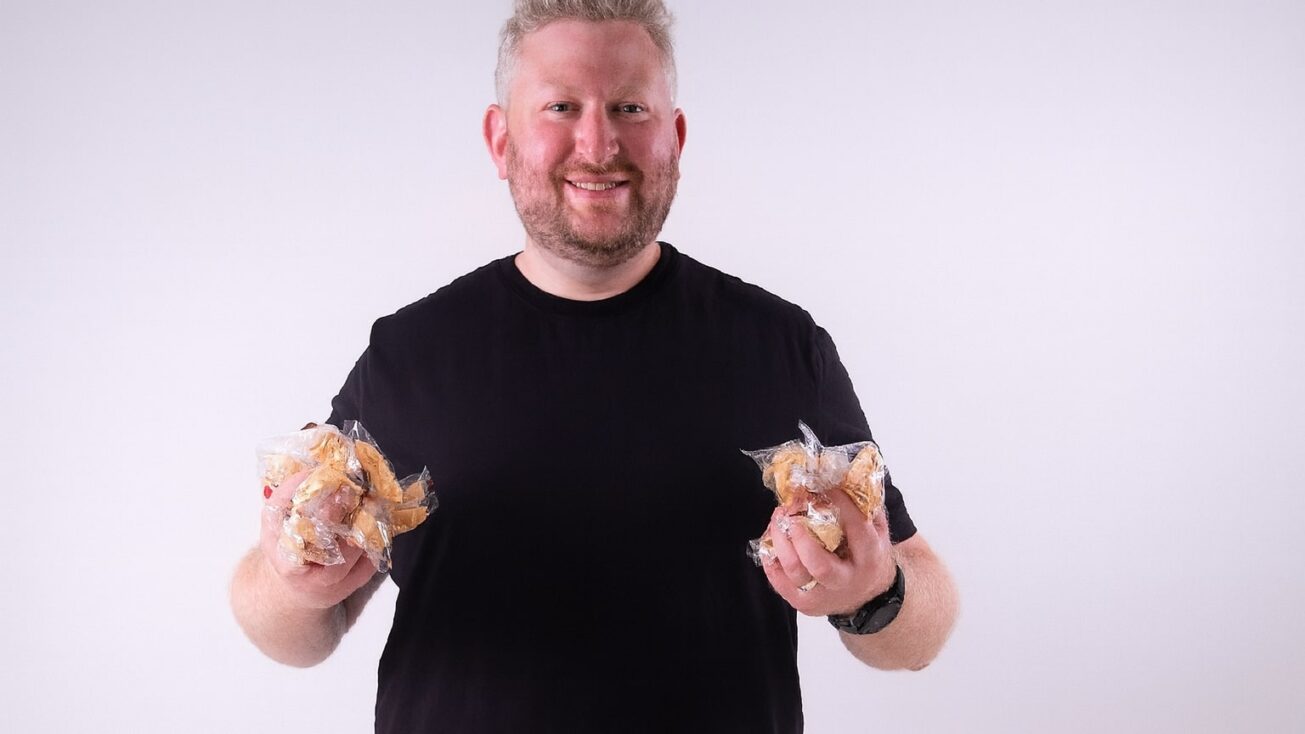
Catalyst by Camber Creek Episode 1: Shawn Porat, OpenFortune
Nearly everyone has had the pleasure of opening—and eating—a fortune cookie. Imagine you open one. One side says love will find you. That’s great. But the other encourages you to find that love at the movies with the latest romantic comedy coming to theaters. Or your fortune is a reminder about the importance of diligence in all your pursuits followed by a nudge to keep your language-learning streak on Duolingo going.
These scenarios are not made up. This is happening now because of our guest Shawn Porat and his company OpenFortune. They’re putting very timely, sometimes irreverent, ads inside fortune cookies, working with big brands like Coca-Cola, Cars.com, and many, many others you’ve heard of.
How does anyone think to even do that? How long did it take Shawn and team to broker the deals and build out the infrastructure? And what are the chances your next fortune will be one that Shawn’s company wrote?
Transcript
Lionel Foster: Shawn, thanks so much for joining us.
Shawn Porat: Yeah, thanks for having me on.
Jeffrey Berman: So I wanna jump right in, because for people that know us and will listen to us, they’ll be a little bit surprised at our choice of guest today. Shawn, can you just tell our listener. Just kidding. It’s tens of millions.
What it is you do?
Shawn Porat: I write people’s future.
Jeffrey Berman: Hold on. That’s actually what you said. When we met we were talking for a few minutes and having an enjoyable conversation, and then I said, you know, we’re at this thing, like, what are you doing?
And he said, “I tell people’s future.”
Lionel Foster: Well, Shawn, that tagline is brilliant. How long did it take you to come up with that?
Shawn Porat: Probably about a week after I started doing this, and I started getting tired of actually saying it the more traditional way I. And then everyone started getting more interested as I said it like that.
So I own all the fortune cookies in the world—specifically about 99.2%, and I partner with brands to integrate them into that experience.
Jeffrey Berman: So, hold on, listener. Listen to that again. This man owns 99.2% of all the fortune cookies in the world. So when you go into your random Chinese restaurant, and you crack open a fortune, this guy is basically telling you whether or not you’ve luck is with you.
Shawn Porat: Yep.
Lionel Foster: Shawn, you gotta explain that ownership piece. What does “own” mean man?
Shawn Porat: So. I mean, and we’re kind of getting into the whole background story of why I got into this, but I guess we’ll start there. I love starting businesses in various industries, learning about those businesses and industries.
And I had a marketplace for buying and selling judgements at the time, court-issued judgments. And I’m sitting in a Chinese restaurant thinking, how do I market this? How do I get customers? And outta nowhere I hear a bunch of laughter at the table next to me. I turn to the side, and I’m watching a family open up their fortune cookies and just read it to each other, laughing out loud for probably 10, 15 minutes, sharing it, taking pictures, putting it in their wallet, putting in the back of their phone case.
And I’m watching this play out solid 10, 15 minutes. And I was shocked. And I said, why can’t people talk about my business that way? I realized, wait a second. What if I made custom fortune cookies, gave it to the restaurant for free and told them, can you give it to your customers at the end of the meal?
And so I approached the manager like, sure, why not? I’ll try it. So I gave him a bunch of custom cookies that I made at a local bakery. He gave it out and everyone talked about my business and everyone went to a website and everyone wanted to learn more about it. And at that point I realized, okay, there’s something much bigger here than just me.
And I thought it would take a few weeks. Let me figure out the distribution. Who handles creating all the fortune cookies out there in the world? Who distributes them to restaurants? You know, it wouldn’t be that hard. Ended up taking eight years to build everything out, sign exclusivity and perpetuity with the factory owners and the main distributors.
Jeffrey Berman: Wait, I gotta stop you there. Exclusivity in perpetuity. And we’re gonna come back to this, dear listener, at the end. But you think about. What this person, what Shawn has done in, you know, everyone remembers fortune cookies when they were a kid, going from just a kernel of an idea to actually having an almost global grip on the market with perpetual exclusivity.
Talk about a moat. Delicious.
Shawn Porat: Yeah, it wasn’t easy at first, and that’s why it took eight years. But the factory owners saw this as additional revenue. It was a no-brainer for them. It wasn’t like they had 50 people knocking on their door asking, “Hey, can I pay you something extra to put brands inside this experience?”
But they were scared that the tradition kind of wouldn’t survive. So we had to create almost like a constitution for the fortune cookie where we had a set of rules that we wouldn’t break. Like always keeping the fortune traditional, you know, stuff like that just to make sure that the experience would always live on.
Lionel Foster: So hit us with the ownership piece. So what can you do? What can’t you do?
Shawn Porat: We could put brand messages on the back. We have to stay away from several categories. Anytime that there’s a complaint, let’s say from a restaurant, we have to remove the cookies. We just have to do a lot of things just to make sure that consumers still have the best experience in the restaurants, and they still feel that the fortune cookie is kind of this supernatural experience.
That, you know, that old idea of some ancient Asian man full of wisdom is writing this. That needs to feel like it’s real and it hasn’t gone away.
Lionel Foster: And so you’re saying that by right you can do that with some 99% of fortune cookies in America.
Alright. And so you said originally you were inspired by the business you were running at the time. “Why don’t people talk about my business that way?” But of course you do this for other brands. So what does that look like today?
Shawn Porat: So we launched in 2018 with Capital One as a partner and it’s kind of funny.
They gave us less than 1% of the budget for that specific campaign. We ended up delivering 62% of the results for the campaign. And it was a shock to everybody. It was a shock to us too. We didn’t expect this type of impact. And what happened was less than 24 hours after the cookies hit the restaurants, the CMO of Buzzfeed randomly went to his local Chinese spot in the city, got takeout for his wife, who was sick at home, brought it home, opened the cookie, saw the Capital One message, took a picture and put it up on Twitter, and wrote, “Ad blockers ain’t got nothing on the New York City takeout market.” And at that point [I]went to sleep, went viral.
Millions of people were looking at that tweet, reposting it on Reddit, 60,000 up-votes, thousands of comments, another 10 million views, and it blew up. Then there were a bunch of media publications that picked it up.
Jeffrey Berman: That’s amazing. That is amazing. And at that point, did you have enough factory throughput? Did you have capacity to build for the amount of demand, the tsunami of demand that was gonna come?
Shawn Porat: So by 2018, we already owned close to about 80% of the market in the US over the following year and a half, we grew to 99.2%. And then,
Jeffrey Berman: Wait. How did it go so quickly?
Shawn Porat: So there are only a couple of factories that own pretty much all production in the United States. So it’s not like there are hundreds. There’s less than a dozen.
Jeffrey Berman: Okay. So when you said 99.2%, you meant the US. I thought I heard global.
Shawn Porat: So global came afterwards. After 2021, we started building global.
Now we’re in 30 countries.
Jeffrey Berman: Got it. Okay. So is that 99% number still accurate for the globe?
Shawn Porat: So it’s actually 100% outside the US, ’cause there’s not many factories that control outside the US. So we are partnered with pretty much all of them that control those 30 countries.
Jeffrey Berman: That’s unbelievable.
Shawn Porat: Yep.
Lionel Foster: So take us inside one of these cookies. If you’re lucky enough to get one that you know your team has written something for, what kind of message are we seeing?
Shawn Porat: So you’re opening it up. You’re seeing a traditional fortune. As I mentioned before, we’re not gonna write, “New York lottery’s in your future,” but we will say you’re gonna come into a lot of luck or prosperity.
Something in the tone of the brand on the back. We recreated the entire printing process, so as you’ve noticed with current fortunes, it’s typically like avery light black ink or a blue ink. Think of something that was done with 40-, 50-year-old technology. They haven’t figured out a way to print in full-color digital images, et cetera.
It took about two years. Now we print digital on all our fortunes to bleed full-color images. You could see someone’s face perfectly on the paper. And, yeah, that’s what you’re gonna see on the back.
Jeffrey Berman: Yeah. I’m a little . . . So Shawn was kind enough to send me some fortune cookies, and unfortunately we’re all packed up ’cause we’re leaving, and I don’t have them handy.
I was gonna crack some on the show, but I opened one, and the quality of the paper is a complete 180-degree difference than what I remember as a kid, which just look like flimsy paper. You know? And it had something cheesy on it. You turn this over and there’s a QR code. It’s incredibly impressive.
Shawn Porat: Yep. And that one was, I believe, interactive brokers.
Jeffrey Berman: Yes, that’s right.
Shawn Porat: Yep.
Jeffrey Berman: So, well actually, now that we’re talking about Interactive Brokers, how did you fund all this?
Shawn Porat: So initially it was just me, then my partner, but that was, we’re talking $10,000, very minimal. Then we brought on a couple of investors. You might know Henry Silverman. He came on board. Then after that we got Shaq Sly, then Gary Vanerchuk, and that’s pretty much it.
Lionel Foster: Sorry. One, one second. Shaq, I assume is Shaquille O’Neal.
Shawn Porat: Yeah.
Lionel Foster: Sly is Sylvester Stallone.
Shawn Porat: Yeah.
Lionel Foster: Okay. Keep going please.
Jeffrey Berman: This, by the way, Lionel, this is gonna get more unbelievable.
Shawn Porat: Yeah, it’s . . . There are a lot of really fun stories, along the way, but yeah, we don’t have a traditional …
Jeffrey Berman: Because what happened was, lemme just tell the story. Yeah. I’m gonna make this up, but this is plausible . . . . [Jeffrey Berman does an impersonation.]
Lionel Foster: Sorry, I just need to make note. I’ve known Jeff for nearly five years. I did not know he had a Silvester Stallone impersonation in him. It’s pretty good, but then he turned it into Andrew Dice Clay at the end.
Jeffrey Berman: By the way, I did that impression for Sylvester Stallone in front of Sylvester Stallone. I don’t think I should have.
Shawn Porat: I wanna hear that story.
Jeffrey Berman: It’s not very good. It’s a little embarrassing. Maybe at the end.
Shawn Porat: Okay. So yeah, but I’ll tell you with Shaq though, he specifically said he only invests in stuff that he loves, and he loves fortune cookies and the entire tradition.
Jeffrey Berman: But how did you get to them? Like this is, that’s a pretty all-star cast.
Shawn Porat: Our investor Henry Silverman had a relationship. So, yeah, through him. We met them and did that deal with Gary V directly. We met him. We knew him for many years, and then we went onto his yacht at Cannes during the ad festival and then made the deal happen on the spot.
Lionel Foster: Amazing. So we’re gonna hear a lot more about the current state of the business and how you operate and all of that, but I wanna hear a bit more about your background. You went to law school. Did you ever practice as a lawyer?
Shawn Porat: Thank God, no.
Lionel Foster: No? Same. Same here. I went to law school.
I did not practice, but my recollection of law school was it was filled with not just rule-followers, but rule-makers, people who felt very comfortable in tradition, precedent. That’s very much not what I’m hearing from you, Shawn. How are you both the kind of person who would start this awesome business and suffer through law school?
Shawn Porat: So I have parents that told me, “You’re either gonna be a doctor or a lawyer.” And I did not wanna be a doctor. I really didn’t want to be a lawyer, but I figured, okay, that seems a little bit better than being a doctor. ’cause I just . . . I’m not a school person. I really didn’t like school. I couldn’t pay attention, couldn’t just sit there.
My mind would wander off places, and when I did go to law school, pretty much to make them happy, I didn’t go to class. So when I was there, I was pretty much focusing on my business, on my laptop, building it up, and I told the professor, “Listen, I have a medical condition. You can’t call on me out of the blue.”
So he left me alone all semester, and I just worked on my business on the laptop. And then I’d skip like a month of class at a time, and then I just downloaded an outline off Outline Depot or whatever those websites are, and I’d get an A in the class at the end. It was great, and that’s what I did for law school.
Jeffrey Berman: So much of that is unbelievable.
Shawn Porat: There’s more to it.
Jeffrey Berman: Oh, keep going.
Shawn Porat: So my second semester in law school, my professors didn’t let that fly.
They told me the first day of class, your grade is based 100% on the final. I’m like, great. I know that from the first semester. Got it. All good. I’ll download my outline. I’ll take my test. All good. I skipped three months of class. I came to class the last two weeks. Professor calls me out and tells me, Shawn, I’m gonna fail you.
I said, “Why are you gonna fail me? I didn’t even take the final yet.” He said, because based on some appellate court ruling, you have to attend 75% of classes. I said, I didn’t know that. You didn’t tell me that the first day in class. I said, “Let me go through this time. I will attend class later.” So then I got curious?
I started researching, and I looked up the laws, and I found something called a New York Law Office study. And the New York Law Office study said that I could pretty much leave law school after one year, have an attorney supervise me on paper for a couple of years, and I could sit for the bar anytime without finishing law school.
So I told my professor, “Let me take my test. I got my A minus, and I said goodbye. Thank you for that. Went to my partner at the time. He signed off that he’s supervising me, and then I got a letter three years later that I could sit for the bar.
Jeffrey Berman: Did you sit for the bar?
Shawn Porat: No, I was way beyond that point already, but the letter came in.
I have it. I have it up on my wall in my room.
Jeffrey Berman: Oh my God. That is so good. You know, there’s something, and I think, dear listeners, you’re gonna hear a common thread from many of the people that we’re gonna speak with, these just outstanding entrepreneurs who categorically hink outside of the box. Shawn, you are certainly an outside-of-the-box thinker from the way that you were thinking about your career and the way that you did law school, from the way that you built the fortune cookie business. We didn’t even talk about what business you were in before the fortune cookie business.
We meet entrepreneurs, and we meet people that don’t necessarily—you can’t peg them. It’s oftentimes the strongest entrepreneurs are the ones that exhibit characteristics of what you’ve gone through and what you’ve experienced.
It’s validating for us as venture capitalists to hear, also thrilling because we love success stories, specifically American success stories.
Shawn Porat: I love that. And, yeah, tell that to my high school self, who didn’t understand why I wasn’t like everyone else just sitting in the class, and I couldn’t handle it.
I was getting my 65 just barely passing. I hated it. Hated it.
Lionel Foster: Did you ultimately get the JD, the piece of paper?
Shawn Porat: So there’s the JD to finish law school, which you don’t get because I left after one year. But then there’s the license to practice law. You pass the bar. I never took the test.
I maybe should one day just the heck of it.
Jeffrey Berman: So you can practice law without a JD?
Shawn Porat: Yeah.
Jeffrey Berman: That’s so interesting.
Shawn Porat: YepI have the letter somewhere. I’ll pull it up and I’ll send it over to you guys.
Jeffrey Berman: if I had free time, I’d do that. Just like, eh, I don’t have a J. I just want to practice law, except it sounds …
Lionel Foster: So, Shawn, how do your parents feel about where you are now?
Shawn Porat: I mean, you should have seen them when I told ’em, “Hey, I’m leaving law school after a year to go make fortune cookies.”
That conversation went really well.
Jeffrey Berman: Do you deliver it to them with a fortune cookie that said, “Hey, break this open for a surprise. I’m leaving law school!”
Shawn Porat: I should have, but the funny part was they lied to all their friends for a solid, like eight to 10 years telling them, “Oh yeah. My son’s a lawyer.”
Jeffrey Berman: Oh my god. Do you have siblings?
Shawn Porat: Yeah. Two.
Jeffrey Berman: So the company now, I would imagine it’s fairly, if not hugely, profitable, right? Talk to us through the mechanics of the business and what you see for the future.
Shawn Porat: Yeah. We are doing very well. Eight-figure business, nine figures in value, and very profitable. Profitable for the last couple years. We’re thinking of ways to expand with the fortune cookie. And I’ll tell you about some of those ways. So the core business is advertising in restaurants.
That’s the core business. After that, it’s expanding internationally to get a bigger footprint. So in the United States and Canada, the tradition is very, very strong. Parts of Europe, UK, et cetera, but I would say 90% of the world, it’s still not part of their weekly or monthly tradition. So we could produce billions more fortune cookies, and make that part of the tradition, and sell advertising into those experiences as well.
So that’s something that’s the next step for us. After that, it’s expanding into outside-of-restaurant experiences. So the fortune cookie itself, people love the surprise and delight. People love being told their future or what’s happening next for them. It’s one of those rare occurrences where the human is open to suggestion, and your guardrails are down because when you walk around your day, you have your guardrails up.
You’re not paying attention to ads. You’re closed off. And here in this intimate moment, there’s nobody judging you. It’s just you and this cookie telling you about your future or what’s happening next for you. Your mind is open and ready. Am I gonna get married? Am I gonna get a new job? Am I gonna come into money?
Am I gonna start a new business? What’s in store for me? And that feeling that people get while they’re open to suggestion is incredibly powerful.
Lionel Foster: I wanna ask you about that piece in particular, because you know Jeff and I are sold. It’s a brilliant idea. But playing devil’s advocate: Some people feel they’re oversaturated by ads in every other part of their life, and then they’re getting a comfort food, Chinese food. They open the fortune.
I could envision some of them going, “Come on. Gimme a break. Why? Why am I seeing an ad here? Do you get that response? And if so, how do you deal with it?”
Shawn Porat: Oh yeah, a hundred percent. What I compare it to is like when you go to a movie theater and you’re seeing a movie and the advertisements come up in the beginning The first time that ever happened, I’m sure everyone you know, wasn’t too happy.
It’s delaying their movie. They paid for a movie ticket. Why are they watching 10, 15 minutes of ads? That’s what happened when we first started doing it. I would say with maybe 5%. People would start complaining like, what is this? That 5% went down to 0.1% after the first couple months when people started to get used to it.
The goal is not to just shove an ad into people’s faces. It’s about hiving them some type of value and making it part of the experience. So that’s when an advertiser does a really, really great job. I’ll give you an example. Duolingo came to us, and they primarily place advertisement to download the app.
That’s their entire strategy: Download the app. We changed the creative to pretty much call out people and say, “This is Duo. You’re not learning your language right now.” And everyone was posting it online and within a few days, one TikTok of the video got millions of views, 600,000 likes, and 100,000 shares.
Just one cookie created that. And that’s what we try and go for with each of our partnerships: Something that compliments the experience and not just a banner placement.
Lionel Foster: So what percentage of the time is anyone in America who opens the fortune cooking at this point, what percentage of the time is it one of yours with an ad in it?
Shawn Porat: So our distribution, it’s 99.2% with an ad. Currently it’s under 10%. So most of America still has not seen this. There’s a lot more fortune cookies to sell through, and we’re being cautious about we partner with and how we do it.
Jeffrey Berman: And when you turn that on or when that gets turned on, it’s gonna be you guys?
Shawn Porat: Yeah. Yep.
Jeffrey Berman: That is outstanding. Outstanding.
Shawn Porat: So what I was saying earlier about the expansion outside of restaurants … One of our partners, Stake, it’s a crypto casino. You probably see them on Twitter, X. They came to us and said, “Hey, and they’re one of our partners in restaurants right now.”
They said, “Hey, can we put the cookie in F1? We’re also sponsors of F1. So then we created these nice branded wrapped cookies and put them into F1. I realized, okay, there’s something here.
Lionel Foster: Shawn, when you say F1, is this “F1” the movie in particular?
Shawn Porat: No, F1 racing in Vegas. So giving out the physical cookies given out during the event.
We started thinking there’s something here. So now we’re, for example, a top-two bank. We’re negotiating a deal to put the cookies at the US Open, Madison Square Garden, other places. Now we’re taking the Fortune cookie and placing it around the world in various experiences.
Lionel Foster: I wanna know more about how the creative works, because with a lot of brands you have, you know, it could be Fortune 500 company.
They have a third party, who helps them with creative, and their copy then flows to, someone who can distribute ads like you, But I’m hearing much more interactivity between your team and the brand. So how, how are you all different there?
Shawn Porat: Great question. We are very different than a typical billboard company.
Let’s say they get the copy, they get the design, they print it and throw it up on the board, and that’s it. Half of our team is creative. Half of the entire team. So we can’t come up with all the creative strategy for all our partners and including interactive brokers. They have a massive team, creative, internally, creative agencies, but who came up with that creative?
We did. We take a lot of pride in coming up with what will go viral, what people will love. ’cause brands just don’t know exactly what to do in this situation, including their agencies, who have never dealt with this size of space.
Lionel Foster: Nice. Talk to me about the demographics of your customer base, the companies you’re working with, who, who tends to latch onto this?
Who tends to get it? I imagine a lot of the names you’ve mentioned so far have been quite big, so I’m curious if there’s diversity in how big the, the clients are.
Shawn Porat: So since we own the fortune cookie, we kind of set the rules on who we work with. And in the beginning, we didn’t understand that quite well. We thought, let’s just go and work with everybody.
Let’s take $5,000 from a brand, $10,000. Let’s do whatever we can do. And we realized that it was very hard with fortune cookies, because you don’t control exactly the day they go into the restaurants, the day they leave the restaurants. There’s a lot of creative that goes into it, a lot of handholding, a lot of reporting.
And we told ourselves, “Why are we just letting everyone have access to this incredible platform that we built? Why not just make it a lot more exclusive for clients that could only afford a certain dollar amount?” So now, for example, we try and take minimums of $50,000 to $100,000 a month.
We have some clients paying over a million dollars a month. And we’re increasing that as time goes on, making it more and more exclusive. That’s why you hear those common names like Capital One, Duolingo, Coca-Cola, et cetera. But we are open to other brands that are not as well known as long as they have the budgets.
Lionel Foster: Yeah. Well, Shawn, you’ve already proven you see the world a little differently from many of us. You see opportunities that might not be obvious. Is there another space you’re seeing that you’re tempted by?
Shawn Porat: Not yet. So our investors have told us, “Hey, you’re gonna run out of space at some point. You’re gonna sell through all the fortune cookies.” What do you do at that point? And we have half a billion dollars of revenue opportunity with just the traditional fortune cookie, half a billion dollars. After that, we are now creating a taco-shaped fortune cookie and putting it in Mexican restaurants and starting a new tradition in America.
And we’ve tested it at over a hundred restaurants, and it’s doing unbelievably well. So that’s the next frontier, and that’s another couple hundred million dollars of revenue opportunity. Again, that doesn’t include the fortune cookie outside of restaurants and new experiences, so at events, conferences. There’s so many different use cases for fortune cookies.
I haven’t even began to explore, like outside of fortune cookies because until, until we sell for a couple billion dollars. At that point, then I’ll look into something else,
Jeffrey Berman: And the amazing thing here is that you found something that would be incredibly difficult for another actor to disrupt from the exclusive agreements with the manufacturers, to the fact that this is IR [in real life]..
So much of the work that we do and the, and the productivity that is gained by humans is potentially being disrupted by ai. This is not something that can be disrupted by ai. This is somebody eating sustenance and having a real-life experience.
It’s tremendous. I can come up with five other things in my head that are food-based, where it’s like, “Hey, we already have the infrastructure for this. We already have the partners, most importantly the advertisers. And their whole goal is: can we create this experience that people are gonna feel is authentic.
Shawn Porat: Yeah. It’s very hard. “There are people that come to me and say,
what stops you from just putting ads on chopsticks or napkins or something else? And it’s so different. It’s not the same. People don’t compare their life to it. There’s not a century-old tradition behind it. It’s not part of culture. It’s not part of weekly dinners with the family. It’s very, very different. It’s very hard for me to find something that’s similar to this at this scale. I don’t think anything like that exists.
But I want to even exit the advertising world a little bit, but stay in fortune cookies later on and open up fortune cookie museums. I wanna own the fortune cookie lifestyle and culture in the world. That’s what I want to be a part of, ’cause there are tens of millions of people that keep the fortune slips after the meal’s over that are part of this tradition.
But there’s no central place for all those people to come together, and that’s what we could do with an app, with a museum, with maybe an apparel company. There’s a lot there in the fortune review space.
Jeffrey Berman: You have this business that’s already very successful and profitable. And if you think about this on an XY axis, right, you can determine whether or not to go really broad, which means other product categories or really deep and really own the fortune cookie experience, the apparel, the museums potentially like a fortune cookie restaurant where different types of food come in a fortune cookie.
The possibilities are limitless on that XY axis.
Given the way you’ve described yourself, are you of the mindset where it’s like, hey, I’m gonna focus on this one category, and is there enough there to excite somebody like you that has a restless mind?
Shawn Porat: Advertising is great and all and the brand integrations. I think I could stay there for the next 10, 20, 30 years doing that. But there’s something about challenging myself to go into spaces that I haven’t been at before.
Creating a Museum of Fortune cookies, similar to an ice cream museum and stuff like that. It’s just something exciting to me to go into other places or creating a taco-shaped fortune cookie or creating an app that people could download and scan their fortunes and connect with other people around the world that got the same fortunes and what it means for them.
I have a list of hundreds more pieces to fortune cookies. That’s what keeps me going—to just keep doing stuff that hasn’t been done before.
Lionel Foster: So, Shawn, especially when you talk about something like a taco-shaped fortune cookie and how you have plans to grow penetration outside of the us. In my mind, this is really getting into human psychology and even sociology. You are actively trying to jumpstart or encourage new consumer behavior. That’s very exciting. It also sounds really hard. Is that just you and your team figuring it out on the fly? Do you work with localized experts? Are you talking to historians?
How does that work?
Shawn Porat: Right now it’s just us using PR, actual placements of fortune cookies in these markets. Introducing it to people, getting them excited, doing, serving on the grounds, understanding how people feel about this. Right now what happens is that we noticed when you put fortune cookies in a new market, depending on which market, there’s two different ways it kind of comes out.
The first way is: oh, this is a joke. It’s cute, it’s not really real. While 72% of Americans think it’s real. How do we get people in other markets to feel this is real? So it’s more about letting them know people’s lives have been changed by the fortune, and there are countless stories that we want to put onto the world of people that have made decisions and changed their life because of the fortune?
Lionel Foster: So thinking again outside of the US over the next five to 10 years, where would you guess would be a place where Fortune cookies might really take off?
Shawn Porat: I would say in South America we’re pushing heavily. In Brazil, Columbia, Argentina, also in Africa, parts of Asia. yYou’d be surprised, but China has no fortune cookies.
Everyone thinks that fortune cookies were created in China. They weren’t. They’re actually from a Japanese immigrant who came to the US and started it here, over a hundred years ago.
Lionel Foster: Before we wrap, Shawn, we covered a lot, but is there anything you wanna share that we did not get to?
Jeffrey Berman: ooh, I have an idea.
Shawn Porat: Yeah,
Jeffrey Berman: I have an idea. Do you have a fortune cookie near you?
Shawn Porat: Do I have a fortune cookie near me? Not a cookie. I have a … actually, I do have fortune cookies. Yes.
Jeffrey Berman: Maybe we leave by you telling us our fortune, say like, this is for you. And we leave our listeners, and Shawn reads our fortune.
Shawn Porat: Let’s see. Oh, there is one thing I do wanna mention too, after this as well. [Reads fortune.] “Your heart’s compass points towards empathy. Let it navigate your choices.”
Jeffrey Berman: That’s strong. But that might be Lionel’s. Do one for me. I’m just kidding.
Shawn Porat: [Reads fortune.] “You’re gonna come into a lot of money next week.”
Jeffrey Berman: Woohoo!
Shawn Porat: I did want to mention too, after October 7 we started thinking of ways that we could use the power of the fortune cookie to kind of make the world a better place. So we ended up putting messages and fortune cookies about stopping hate and having more empathy, et cetera, and put them near college campuses. So that’s something that we did. We put millions of cookies there. Then the local Fox station in New York, Fox Five, learned about it and did a segment on it.
And after that, Bob Kraft reached out to us and said, “Hey, can I put the blue square inside the fortune cookie, telling people to stop hate and stop antisemitism?” So we’re like, wow, this is fascinating. That we could use our platform. That starts conversations at dinner tables, and everyone pays attention to not just give brands exposure but change public opinion on something as well.
So we did that partnership and then now we’ve been having a lot more conversations with family offices foundations, ultra high net worth folks to use the fortune cookies to change the way people think in the US. So that’s something that I think has been pretty interesting.
Lionel Foster: That’s tremendous. And just to be clear: by October 7th, you mean October 7th, 2023.
Shawn Porat: Yeah.
Lionel Foster: Attacks in Israel and the repercussions of that.
Shawn Porat: Yep. Right after that, we saw a lot of hate in America and a lot of hate at college campuses, so we felt like we needed to do something.
Lionel Foster: Thank you, Shawn. Thank you for your work. Thank you for your amazing story and sharing that so generously. This was fun.
Shawn Porat: Yeah, no, I appreciate it. Thanks guys.
Jeffrey Berman: Thank you.