



How Kevin Bacon Helped Spark a Social Impact Movement
At the University of Maryland, the actor Kevin Bacon funded a “Shark Tank”-style competition for young social entrepreneurs. Instead of investing in skincare brands or gourmet cookies, judges heard pitches from students who wanted to right some wrongs in the world and help people.
That competition grew into the University of Maryland’s Do Good Institute, which supports classes and research and uses social entrepreneurship to help students learn, lead, and grow. Camber Creek spoke with Jenny Cox and Nathan Dietz from the Institute about what happens to a giant college campus when an entrepreneurial mindset is taught, encouraged, and rewarded.
The transcript has been edited for clarity.
Lionel Foster: All right, Jenny, Nathan, welcome to the podcast.
Nathan Dietz: Thank you, and thanks for inviting us.
Jenny Cox: Yeah, we’re super excited to be here.
Lionel Foster: Glad to have you. So what is the Do Good Institute?
Jenny Cox: I always love our name, and a lot of people say, “That actually exists? What is that? Where are you based?”
We’re based at the University of Maryland, housed within the School of Public Policy. The Do Good Institute is essentially a hub for social impact. We provide funding, education, and resources to support students who are passionate about social change.
We offer programming, we have a research wing that Nathan leads, and we’re really passionate about educating the next generation of social impact leaders.
Nathan Dietz: Let me follow up on that. I’m the research director, and my work continues what I’ve done in the past—first as a federal employee with what’s now AmeriCorps, and later at the Urban Institute, where Lionel and I worked together.
I collaborated with the Institute’s director, Bob Grimm, on research around volunteering, philanthropy, and civic engagement. That work now continues in a university setting.
Part of my role is setting context for our programs, understanding what volunteering and charitable giving look like in the US so we can design programs that meet student needs.
We’re also increasingly focused on measuring impact, tracking the long-term effects of participation in Do Good programming. That’s an important objective for us.
Lionel Foster: So lay the groundwork for us. What does your programming look like? Who do you work with, and what outcomes are you trying to achieve?
Nathan Dietz: We’ve recently expanded significantly. We now offer a full spectrum of programs, from when students arrive on campus through graduation and even beyond.
The Institute began with the Do Good Challenge, a large campus event where student entrepreneurs pitch their ideas to a panel of judges. It was a huge success and helped establish the Institute’s identity.
Today, we support students at every stage. We have Impact Interns, which provides employment opportunities, introductory courses like “University 101,” and intermediate programs like the Changemakers Forum.
We also run an accelerator for more advanced student ventures preparing for the Challenge finals.
We’re now equipped to support students regardless of their experience level or stage of idea development.
Lionel Foster: So this all started with the Do Good Challenge. When did that begin, and what was the origin story?
Jenny Cox: I’ll actually go back one year earlier to 2011.
A couple of students were in a campus cafeteria late at night and noticed large amounts of food being thrown away. That sparked a conversation about food waste, not just on campus, but nationally.
They started small-scale food recovery efforts, redistributing surplus food to local organizations.
A year later, our founder Bob Grimm had an opportunity to collaborate with Kevin Bacon’s nonprofit, Six Degrees of Kevin Bacon. Together, they created the Do Good Challenge, a “Shark Tank”–style competition focused on social impact.
Students had a semester to develop solutions to social problems, and judges awarded funding to the best ideas.
The very first winner was the group tackling food waste, what became the Food Recovery Network.
That project grew into a national nonprofit, now operating on over 190 campuses in 46 states, recovering over 12 million pounds of food and providing more than 10 million meals.
It’s a great example of how a small student idea can scale into a major impact.
Lionel Foster: That’s incredible. Let me make sure I’ve got this right. Students start solving a food waste problem. Then Kevin Bacon’s foundation collaborates with your school. The Do Good Challenge is created, those students win, and that momentum eventually leads to the Do Good Institute.
Jenny Cox: Exactly.
Lionel Foster: All right. This is an important moment. I want to count my degrees of separation from Kevin Bacon.
Me to you is one, you to the foundation is two, and the foundation to Kevin Bacon is three. So I’m three degrees away.
Jenny Cox: I think you’ve got it.
Nathan Dietz: I think of it as you to us, us to Bob, Bob to Kevin—purely personal connections.
Lionel Foster: I love it.
Nathan and I used to work together at the Urban Institute, so that’s how we know each other. I saw he was working at this place called the Do Good Institute, and within about 60 seconds of reading about it, I knew I had to reach out.
It sounds improbable, but I love what you’re doing.
At Camber Creek, we work with entrepreneurs, and while entrepreneurship is a profession, it’s also a mindset: identifying problems, mobilizing resources, and iterating toward solutions.
Does that align with how you think about your work?
Nathan Dietz: That description is perfect. It applies directly to social entrepreneurship.
We teach students to approach social problems exactly that way, not to get stuck on how big or difficult the problem is, but to move quickly toward action and solutions.
Jenny Cox: I would also say a big effort we make is when students are here in their first year on campus, educating them. We do a lot of classroom presentations. Faculty are so gracious to let us come in and speak to their students about this idea of social impact.
We really encourage students not to wait, to debunk this idea that they need to graduate before they can make an impact. The University of Maryland is increasingly focused on hands-on, immersive learning experiences.
For us, it’s about bringing that into the social impact space. We ask students: what resources do you have? What knowledge do you have? Who are the people around you that you can work with? And how can you take action?
These are complex issues, so we also want students to be informed. A great example is a course called I Give, where students run a grant-making process as a class.
They pick a social issue, research it, send out requests for proposals, work with nonprofits, and ultimately award a grant.
Students leave that experience energized. They realize they can make a difference in a single semester. But they also learn that giving money is harder than it looks. It’s not just about having resources; it’s about being informed and intentional.
They walk away understanding things like requests for proposals, experiences many students don’t get.
That leads to additional opportunities, like supporting nonprofits with summer interns. Students bring skills like social media, marketing, and programming support, while nonprofits provide meaningful, mission-driven experience.
So immersive, hands-on learning is core to what we do. We’ve applied that model across other sectors. Why not apply it to social impact?
Nathan Dietz: Mm-hmm.
Lionel Foster: I love that. I’ve heard a few different ways students can get involved. Could you give us a quick list? There’s the Do Good Challenge, courses. What are all the entry points?
Jenny Cox: Great question. At the top of the funnel, we have ambassador programs where students help with events and outreach.
Then there’s Changemaker Pathways, which is great for first- and second-year students. It’s cohort-based, includes a day of service, and introduces concepts like the social change wheel, helping students understand different roles in social impact.
We also support academic courses. Faculty affiliated with the Institute teach classes like I Give and Do Good Now, where students tackle social issues hands-on.
Beyond the classroom, we have Impact Bootcamp and Accelerator Fellows, programs for students with ideas they want to scale. Accelerator Fellows even provides stipends so students can effectively be paid to work on their own initiatives.
We offer mini-grants—small-scale funding, usually up to $500—for student groups running events or projects.
There’s also Impact Interns, a summer program where we partner with nonprofits and help subsidize internships for students.
More recently, we launched the Do Good Campus Fund, over $200,000 in grants for students, staff, and faculty to support immersive learning initiatives across campus.
These projects often involve partnerships with local communities, schools, and organizations. It’s been exciting to see the collaboration that’s come out of that.
We’re really trying to meet people wherever they are, no matter their level of interest or stage in their journey.
Lionel Foster: Is this all centered at College Park, or does it extend to other University of Maryland campuses?
Jenny Cox: Right now, it’s centered at College Park. You have to be a University of Maryland student to participate.
That said, through programs like Impact Interns, we partner with organizations across the US. And Nathan’s research work has broader impact beyond campus.
Nathan Dietz: Yeah.
Lionel Foster: When I think of the University of Maryland, I default to College Park, but there are multiple campuses. Do you have activity beyond College Park?
Nathan Dietz: Not much yet. We’re focused on scaling within College Park first. It’s a large and complex campus with 17 schools. That alone is a big challenge.
Lionel Foster: Right. And just to put that in perspective, how many students are there?
Nathan Dietz: Around 35,000.
Jenny Cox: I’d say closer to 40,000.
Lionel Foster: So roughly 40,000 students. Of those, how many do you reach directly or indirectly?
Jenny Cox: That’s one of our key goals, expanding reach. Right now, I’d estimate about 10–15% of students have some level of engagement with us.
We’re working to grow that by getting into more classrooms and expanding program capacity.
We also collaborate with deans and leaders across schools—journalism, engineering, social sciences, computer science—to find ways to partner rather than duplicate efforts.
There’s a lot of great work happening across campus, and we want to complement it, not compete with it.
Lionel Foster: When you say 10 to 15%, is that the number of students you’ve touched directly, or does that include the multiplier effect of exposure?
Jenny Cox: That probably doesn’t include the multiplier effect, because that’s difficult to track. When I say 10 to 15%, I’m referring to students who have had some direct interaction: attended a presentation, participated in a program, or been part of an event we partnered on.
We also run the Do Good Challenge and sponsor smaller classroom competitions where student groups compete for grant funding or award grants to local organizations. All of those efforts combined make up that 10 to 15%.
Nathan Dietz: I think that’s actually an understatement, not just because of the multiplier effect. People who participate in our programs or attend presentations talk about it with their friends and networks.
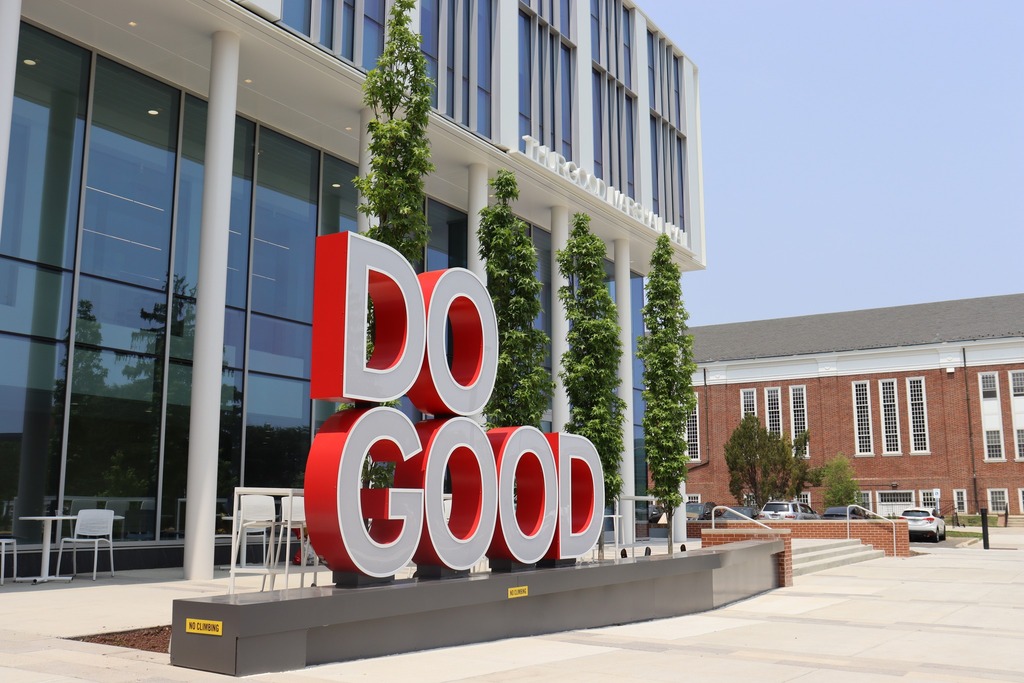
We just finished the spring recruitment cycle for incoming students, and nearly everyone who visited campus came through our building first. They saw the Do Good sculpture and learned about our work.
There’s also an interactive structure called the Rings. When you walk through it, motion sensors trigger recordings of people sharing their experiences with social impact and entrepreneurship. Everyone goes through that, prospective students and their families.
So I think it’s fair to say that almost everyone who visits campus hears about the Do Good Institute.
Lionel Foster: It sounds like you’re an important part of the culture at College Park, maybe even shaping it. You touch a lot of students and collaborate across departments.
How did this become so expansive? Was it student demand, faculty engagement, leadership, or something else?
Jenny Cox: There are a lot of factors. One is a broader national trend. More students, especially Gen Z and younger, are passionate about social causes.
You see this in consumer behavior too. People want to support products tied to a cause or mission. That reflects a broader desire to make a difference.
We’re also living in a time where there’s a lot happening globally, and students feel compelled to act, whether through their major or in their free time.
The University of Maryland has stepped up to meet that demand, and the Do Good Institute was established at the right time to ride that wave and support students.
Nathan Dietz: The data backs that up. There’s a long-term trend over the past 35 years showing that students increasingly want both to earn a good living and to help others.
The Higher Education Research Institute at UCLA has tracked this through surveys of incoming freshmen. Decades ago, those goals were seen as separate: either you pursued financial success or social impact.
But over time, both objectives have risen together. In recent surveys, over 80% of students say both are important.
So students today want to succeed financially and make a positive impact.
Lionel Foster: That aligns with what I see working with entrepreneurs. Some are focused purely on profit, but many want to build something meaningful as well.
I’m curious. Before students engage with the Do Good Institute, do they believe they can make a difference? And do they understand the range of ways they can have an impact?
Jenny Cox: It varies. Some students come in already deeply engaged. I’ve met students who started organizations at 16, or who arrive with fully registered nonprofits at 18.
They’ve been mobilizing resources, organizing communities, and tackling issues for years. It’s incredible.
But on the flip side, some students feel skeptical or cynical. It’s easy to feel overwhelmed.
Our goal is to show them the ripple effect, that small actions can lead to larger change.
We focus on storytelling, sharing examples of students who were once in their shoes and went on to create meaningful impact.
We also have spaces like Do Good Plaza with large “Do Good” letters and the Rings exhibit, where students hear real stories of impact.
That helps counter skepticism and shows what’s possible.
Nathan Dietz: The plaza and those installations reflect our commitment to reaching more students.
We could have stayed focused on a small set of programs like the Do Good Challenge, and mini-grants for top student entrepreneurs. But we realized we needed to expand.
There’s a silent majority of students who may not know where to start. Some are struggling to balance classes, work, and life. Others are new to campus or unsure how to get involved.
Now we’re trying to reach all of them, showing how to get started and how to keep going once they find their passion.
Jenny Cox: Mm-hmm.
Nathan Dietz: You know, goal one for us has always been—for entrepreneurs and non-entrepreneurs alike—to get students to identify their passion. Something they feel passionate about addressing—a social problem that really feels like something they need to devote time and energy to. And once they have that, we can tell them how to get started and how to keep going.
I think that’s been really effective, not just for our student body, but in showing the world that we’re committed to making sure everyone has these opportunities.
Lionel Foster: That’s tremendous. One thing that occurs to me is that through the Do Good Institute, you have access to a very large cohort of engaged, hopeful, hardworking, and creative students.
As a result, do you think you have a different sense of what that college-age generation is like compared to someone who doesn’t work with them every day?
Jenny Cox: We’re definitely an optimistic bunch around here, and it’s hard not to be.
We come into work and get to be surrounded by students who are so driven, creative, and connected to these issues. They’re seeing these challenges firsthand and choosing to lead with optimism.
Why wouldn’t you be inspired by that?
A lot of us feel hopeful about the future because we see the students who are shaping it.
Nathan Dietz: I agree 100%.
I think the reason I feel so positive is that our students take advantage of opportunities to connect and work with others.
It’s very easy these days—for both young people and older people—to go through life without interacting with others unless absolutely necessary. That’s partly an artifact of the pandemic.
When we study trends like declining volunteer rates or fewer people giving to charity, we see more people disengaging from those activities. The research I do focuses on those national trends, but our work with students is an effort to counteract them.
I think we’re successful, at least at the level of our student body, which includes tens of thousands of people. It’s hard not to be optimistic when your job is helping motivated students stay on track.
But we also know how to engage students who aren’t already motivated, helping them discover how they can make a positive difference. And that’s exactly what the world needs right now.
Lionel Foster: I want to repeat something you said because it struck me. You said, “It’s so easy to not come into contact with people unless you really have to.”
That really hit me, because it’s true. And it has serious implications for individuals and for society.
So what you’re doing is incredibly important.
Nathan Dietz: It’s a common thread across all our programs.
Even our earlier programs, like the Do Good Challenge finals, focused on building networks—connecting entrepreneurs with coaches, funders, and peers. That’s essential for any kind of success.
But now, network-building is even more intentional across all our programs. Most are cohort-based, so students aren’t just learning individually. They’re learning alongside others at the same stage. That’s incredibly valuable.
College is supposed to be a place where people form connections, but that’s harder in today’s world.
If we can create those opportunities, we’re not just teaching social entrepreneurship. We’re helping students become better citizens and better people.
Lionel Foster: Before we wrap, we’ve talked about your impact on campus, but I imagine your reach extends beyond it.
Can you tell us about partnerships or initiatives that bring your work to other places?
Nathan Dietz: Sure. The research we do extends our reach beyond campus. People look to us for insights on issues like declining civic engagement.
For example, I worked with the Generosity Commission in 2023 and early 2024. They wanted to understand why fewer people are volunteering or donating to charity.
While total dollars donated have increased, the percentage of people giving has declined. That’s a warning sign for civil society. These trends predate the pandemic and political changes. They’ve been building for years.
Our research looks at how engagement in communities and philanthropy are interconnected and how declines in participation can reinforce each other.
These insights are still relevant today, and I’m often asked to speak about them.
Importantly, this is a nonpartisan issue. Helping communities and supporting one another isn’t political. It’s fundamental.
Our goal is to help students understand that and act on it.
Lionel Foster: I love that. Your work is grounded in students and local communities, but it scales up to inform how we think about society as a whole.
That’s really impressive.
Nathan Dietz: Thank you. I wish we had more time. We could talk about this for another hour. It’s what we do, and it’s what we care about.
Lionel Foster: Jenny, Nathan, thank you so much—for your time, for your work, and for representing what students are doing every day.
Jenny Cox: Thank you so much for having us.
Nathan Dietz: Great to talk with you, Lionel.