



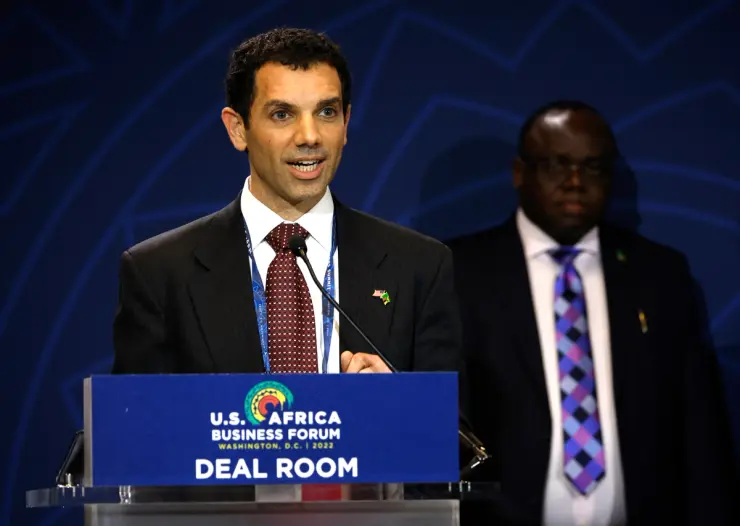
If We Don’t Run Out of Lithium, Josh Goldman Will Be One Reason Why
Josh Goldman would never describe himself this way, but he may be one of the most important people in the world. As co-founder of KoBold Metals he has helped develop technologies that do a much better job finding deposits of lithium, nickel, cobalt, and copper, and do so at a fraction of the billions of dollars that have become the industry average.
These are items on a shortlist of what governments call critical minerals, which are vital for energy production. So, basically, Josh and his colleagues are helping keep the lights on. For example, KoBold uncovered what it projects will be one of the largest copper mines in the world. That deposit in Zambia is one reason the company, a startup, is already worth a few billion dollars.
To reach this point, Josh and his team have had to solve tough scientific problems, navigate domestic and international politics, and take a firm stance against corruption. He credits his training as a physicist with helping him think through the things that really matter and how to approach them.
The transcript has been edited for clarity.
Josh Goldman: Good to be here. Thank you, Lionel.
Lionel Foster: All right, so you and I have known each other for many years. When we met more than 20 years ago, you were a physicist—not even with your PhD yet, you were like a baby physicist—and now that’s not what you do every day. How did this happen?
Josh Goldman: Yeah. Well, it takes a long time to become a physicist, actually. You can’t hang your hat up as a physicist with an undergraduate or master’s degree, really.
I studied physics because it’s really interesting and the problems are hard, and nobody goes on and does a graduate program in science unless you really like thinking about hard problems.
The actual day-to-day of science, especially experimental science, is kind of miserable. You’re sitting there trying to get the device to work, you’re fiddling with soldering things, or you’re in the clean room, or you’re doing some other flavor of TDM that Cobalt’s chief philosopher, Michael Trevin, in his book The Knowledge Machine, talks about—how the scientific enterprise has mastered the ability of getting these really bright, ambitious, hardworking, careful people to spend most of their time on tedious collection of minutiae.
Lionel Foster: Mm.
Josh Goldman: And it’s accurate. That is the material that science is made of. But you do it because you’re interested in the questions you have to answer, and you do it because you’re interested in learning about the world.
I was drawn to physics in high school because I really liked the type of problem-solving that you had to do to understand the physical world.
And I liked that we got to reason about really big and hard things—the smallest particles that make up the universe, and then the universe itself.
After four years of studying those things in college, I was totally unsatisfied with how much I knew about them, and I needed to learn a lot more. So I wanted to keep studying.
I also knew—I was well advised, and I had a correct intuition—that physics was a good degree for a generalist.
I think it’s the best grounding in first-principles thinking.
You see this now at Cobalt—we’ve hired a lot of physicists, physicists who’ve gone off and done other things. They practiced as scientists, and then most of them have gone and practiced as data scientists. That’s one of our core technical disciplines.
The reason is because they’re just really good at first-principles thinking.
One who we hired recently, who I knew a long time ago when we were both graduate students, described his career as bringing the physicist mindset to different kinds of problems.
And you have to go learn the physicist mindset first.
I didn’t know at the time what all those other problems would be, but I liked the way that I was having to learn and kept doing it for a while.
Lionel Foster: Do you remember a particular moment when it hit you how much tedium would be involved if you remained a scientist every day, nine to five? Paint a picture for me.
Josh Goldman: One of the things I had to do as a graduate student was polish pieces of metal to really good finishes.
We wanted—I was attempting to trap single electrons in microfabricated traps and also cylindrical traps at centimeter scale—and you really didn’t want stray electric fields, so you needed these nice, smooth surfaces.
There were different polishing cloths and different pastes you needed to use, depending on how your metals were treated and how well they responded versus getting little ruts in them.
There were many days that were just spent polishing metal.
It’s funny—I knew that if you become a principal investigator, you build a group, you’re not the one doing that anymore, your miserable students are—but still, that’s the nature of the tedium of science.
It’s required because, as the philosopher Nancy Cartwright says about the laws of physics, they can be observed in a precise way in the laboratory not just because they’re correct descriptions of the physical world, but because of really good engineering.
You’ve made a system where you’ve managed to get rid of all these sources of noise and complexity so that you can observe just the thing you’re trying to observe.
And that’s the thing that takes all the effort.
Lionel Foster: You mentioned Cobalt has a chief philosopher.
Josh Goldman: Yeah. It’s on our website.
A well-known journalist reached out wanting to chat with Cobalt because he learned we had a chief philosopher.
We got on the call, and he was very disappointed to learn that our chief philosopher is an epistemologist and not an ethicist.
He thought, a mining company needs an ethicist.
Actually, ethics is incredibly important to our business—you can read about that on the website—but we don’t need gigantic brains to figure that out. The ethical principles are pretty easy to state.
They’re not hard to follow, but they require storytelling to build them into the fabric of the company. That’s an everybody thing, and it requires leadership.
But the scientific and meta-scientific questions at Cobalt are really hard.
We’re trying to look under the ground for minerals—our business is exploring for deposits that have critical minerals like lithium and copper.
These are things we need to build a future economy powered by AI and batteries—a fully electrified economy.
We need raw materials to power data centers, power lines, batteries, vehicles.
Those deposits are under the ground where you can’t see them. The ones that were easy to find have already been found.
The next deposits are concealed—by soil, vegetation, or even hundreds or thousands of meters of rock.
The methods that worked before don’t work anymore, so we have to invent new ones.
We’re trying to make inferences about things we can’t see.
We generate hypotheses and invest capital behind them—like a venture capital portfolio. Most projects will fail, and we need to pick the right ones.
So how do we generate high-quality ideas? How do we design exploration programs to test hypotheses?
These are questions about the nature of knowledge—about reducing uncertainty.
We’re spending money to get information, and that information is only useful if it reduces uncertainty.
So reasoning about and quantifying uncertainty—those are epistemic questions.
That’s why we brought in a philosopher.
Lionel Foster: Does he have office hours?
Josh Goldman: They’re by request.
Lionel Foster: Nice. You mentioned physics as a generalist degree.
Josh and I know each other from the British Marshall Scholarship—we studied in the UK.
What did you study there?
Josh Goldman: I did my undergraduate in physics. Then my first year in the UK was applied math and theoretical physics at Cambridge.
Then I went to London and studied history of science, technology, and medicine—basically history and philosophy of science with a focus on 19th and 20th century physics.
Lionel Foster: You were one of my fellow Marshall Scholars who teased me for having an alphabet soup of degrees, but you probably have just as many.
Even after London, I went on to get a JD.
I liked that because it’s a generalist degree you can use in business, policy, government.
Physics might be an even more powerful multipurpose intellectual tool.
Josh Goldman: Absolutely.
Lionel Foster: So how did you transition to the private sector?
Josh Goldman: I always knew I wanted to work at the intersection of the energy sector and technology.
I got a strong grounding in science as a graduate student, then worked as a consultant at McKinsey in Houston with oil and gas companies, power companies, and industrials.
I wanted to understand the incumbent energy industry.
Then I worked with my co-founder—someone I met as a graduate student—and we worked on private equity investments in oil and gas.
We used technology and physics to identify undervalued opportunities and make better predictions.
Around 2018, we decided to stop working on fossil fuels and focus on the low-carbon economy.
We started from first principles—what materials will the future economy need?
Copper to move electrons, lithium for batteries.
We have the periodic table—we know lithium is the best mobile ion. We’re not going to invent new elements.
Then we looked at supply.
There’s no shortage of these elements in the earth’s crust—there are orders of magnitude more than we’ll ever use.
Lionel Foster: Hmm.
Josh Goldman: The problem is that what you need is not a lot of—you know, the sort of paving stones in your driveway have 20 parts per million copper in them or something like that. What you need is not just a large amount of metal. What you need is you need it concentrated, and that’s what an ore deposit is, or is an economic concept.
An ore deposit is a place where geological processes have scavenged these metals from a very large volume of rock, and they’ve redeposited them in a much more concentrated form.
An ore deposit for copper is something like 1% copper by mass, and then you can take it the rest of the way to 100% copper with industry, at prevailing commodity prices.
So what we’ve got to find are these really special places in the Earth’s crust where natural processes have done most of the work for us already.
Those are the things that are rare, and it’s not like there’s many of them out there that we know about that aren’t being mined because of regulatory challenges or community challenges or whatnot.
Those things are very important, and they can be material impediments to development. But the thing that matters the most is not the nurturing of the babies, it’s the birthright itself, which is that we actually are finding vastly fewer ore deposits than we have previously.
Lionel Foster: Hmm.
Josh Goldman: And the scarcity is not the number of ore deposits that are out there in the world. It’s information. It’s about our knowledge of where these ore deposits actually are. That’s the scarce resource.
It’s not the lithium or copper metal in the ground. It’s information.
And so we decided to start a company to get much better at finding these ore deposits under the surface and inventing the technologies that make us more and more effective, which is the opposite of what’s been happening in the industry over the last several decades.
Lionel Foster: I watched a fantastic presentation you gave.
And I’m doing this from memory, but in there was a cross section of part of the Earth, and what you were explaining in the video is that so many of the deposits that we’ve had access to and have exploited over the past 120 years or so are much closer to the surface.
There’s a whole lot more when you go down, but the further down you go, the less you can see and without the right kind of calculations and even technology, the less you can intuit.
Which is why you’re talking about information being the real scarce resource and not the deposits themselves.
Josh Goldman: That’s exactly right.
The ore deposits—I think what you’re describing is that essentially the vast majority of ore deposits that have ever become mines were found either literally sticking out of the ground or really close to the surface where they’re easy to detect.
Sticking out of the ground, copper sulfide minerals—when ore deposits form and get exposed to air and water—they often turn blue and green. Think of the patina of the Statue of Liberty.
So humans have been noticing these strangely colored rocks for a long time.
A lot of the things that Europeans in Central Africa claimed to have discovered—there are famous stories about having shot an antelope that collapsed on some outcrop and stained the outcrop, and there was this great copper deposit.
In fact, that story is apocryphal. The people who lived there knew exactly where these unusual rocks were, and asking people in a village where they found things like this led to the knowledge by recent arrivals of where all of these outcrops were.
So that movie is largely over.
But what’s important is that those ore deposits that were exposed at the surface or were close to the surface—they weren’t formed there.
We know how these types of ore deposits were formed because we know the pressures and temperatures at which they were formed.
We know the recipe for cooking an ore deposit—the physical and chemical reactions—and they happen thousands of meters below the surface.
Lionel Foster: Mm-hmm.
Josh Goldman: And so the ones that wound up at the surface were actually moved there. Ore deposits were transported.
They were lifted up by tectonic processes—think ancient continents colliding and forming mountain ranges like India hitting Asia and forming the Himalayas—and then they were exposed by erosion.
So you can think of the surface of the Earth today as an erosional surface. We’re scraping off rocks today.
Think of it like the sliced-off end of a loaf of raisin bread.
Lionel Foster: Mm-hmm. Right.
Josh Goldman: Where you sliced, you can see some raisins.
But if you know the recipe, you know that there are many, many more that you can’t see.
So the vast majority of the great ore deposits are still out there to be discovered.
And the problem, as you were saying, is not the natural endowment of these ore deposits—it’s our ability to find them.
Lionel Foster: Your work is just so rife with useful metaphors, and I’m making one up now, but the picture I have in my head is imagine there was a gigantic pile of gold coins that spilled down a canyon.
Some of it spilled along the cliff’s edge where you have access and you have a metal detector, and sure, nearly everything near the edge of the cliff you can detect and point to.
But most of it is down that canyon and you can’t get down there.
So it sounds like your data is mapping as much of the depth of that canyon as possible, which is telling your team where to dig.
Josh Goldman: Yeah, I think that’s a really good description.
You can think of it in two ways.
Sometimes you know that there was one event—or you hypothesize that there was one event—that formed a lot of concentration of minerals, or maybe you detect that in one location and you want to know the extent.
You’re looking in some huge volume of rock.
Remember, the ability to probe the subsurface is really limited.
You think of a road cut or a mountainside—you can see how complex the rocks are—and typically when you walk across the surface, you’re just collecting a rock sample at the surface. You’re seeing just one edge, and you’re supposed to make predictions about everything that’s below it.
When you drill a hole, this is what drill core looks like—it’s a few inches in diameter, and we drill holes that are well over a mile long.
And this is all the information you get, and it might be several football fields away—hundreds of meters—to your next hole.
So we’re trying to predict what’s in between those things.
And that’s in places that are high information density as far as it goes, because you actually have some samples from below the surface.
Lionel Foster: And just for the audio, that drill core you just held up is, like you said, a few inches wide and maybe a foot and a half long.
Josh Goldman: This is about a 30-centimeter piece out of a drill core that’s a mile long.
And this is just one sample.
It’s broken up in meter lengths so it can be put in a box and carried to our science campus.
But this is the data in physical form—this cylinder of rock here.
The data is always really sparse.
We have one little two-inch diameter hole here, and then four football fields away we’ve got another one.
And that’s high information density.
Usually we don’t even have that information.
So there are cases like you’re describing where we see some mineralization at the surface, or a few inches or meters in a hole, and we want to predict whether it continues, whether it’s extensive, whether it’s economically significant.
Then upstream from that, you have to decide where to drill in the first place.
You have to generate a hypothesis, acquire rights, get there physically, keep people safe, get consent from landholders and communities.
It takes a lot of work and money to collect new data.
So it behooves us to predict where our chances of success are best.
There isn’t one magical product that predicts ore deposits.
There are dozens of products—hardware and software—guiding all the decisions along the way.
Lionel Foster: Because you’re still very much a scientist, you sound so excited just talking about the process of finding these things.
What does it feel like when you actually find a deposit?
Josh Goldman: That’s what we’re here for.
The point of the discovery machine is to produce discoveries.
It’s very exciting because you get to see real things happening in the physical world.
What’s happened in Zambia—our biggest success so far—is an extraordinary copper deposit we call Mingomba.
We think it’s likely the best undeveloped copper deposit in the world.
What’s really special is the grade—the concentration of copper.
The global average today is just over 0.5%.
Our deposit is about 5%—ten times more concentrated.
That’s huge because cost depends on how much rock you move, but revenue depends on how much metal is in the rock.
So ten times the concentration means ten times the revenue for similar cost.
We started exploring in late 2022.
By 2023 we had major drilling underway.
By 2024 we had found a large contiguous resource.
By 2025 we’re designing the mine.
Now it’s real—not just an idea.
We’re planning how to extract, process, and operate.
We’re doing environmental and social impact assessments.
Cobalt now has over 300 employees globally, about 100 in Zambia, plus hundreds of contractors.
We’re breaking ground soon.
This becomes a multi-decade company—the largest copper mine in Zambia.
Lionel Foster: Talk to me about financing. What was it like pitching this to venture capitalists?
Josh Goldman: We raised our Series A in 2018, co-led by Andreessen Horowitz and Breakthrough Energy.
We were Andreessen’s first mining investment.
At the time, “critical minerals” wasn’t a common phrase.
We also made an early decision not to be a service company.
We weren’t going to sell software or services.
We were going to build technology and use it ourselves to explore.
We were going to build an exploration company.
Lionel Foster: Mm-hmm.
Josh Goldman: We’re going to require exploration rights. Then we’re going to operate exploration programs, and we thought that was necessary really for two reasons.
The first one is value, and when you find something—a high-quality mineral resource can be really valuable—and all of that value accrues to whomever owns the exploration and eventually the mining rights, because there’s not one day when you go create enormous amounts of value.
You have to make many, many decisions and you have to expose risk capital at each one of these steps.
And so the party who’s deploying that risk capital is going to be positioned to get the returns, not somebody who’s an advisor to that company selling them a software service.
But the other, even more foundational reason is that we believe that to invent technology that’s really powerful for mineral exploration, you have to do it inside an exploration company.
Lionel Foster: Hmm.
Josh Goldman: We have to pull in these new brains to the problem. We have to hire amazing geoscientists, but then they have to work with technologists, with data scientists and software engineers and hardware engineers.
We knew that we needed to do this in a highly collaborative and iterative way by making the technologists just be explorers.
People at Cobalt often say, we’re all explorers, and everybody has the same incentives.
We’re trying to find deposits, and we’re trying to find them faster and with a higher success rate or lower expenditure on failures in order to produce those winners.
We’re trying to make this rare find into a systematic and repeatable process with technology.
We knew that in order to effectively develop technology, we needed to get these multidisciplinary teams—a geologist, a data scientist, a software engineer—working together on exploration problems, individual exploration problems, trying to make a discovery in this place with this volume of rocks.
And then more generally on exploration problems, trying to take what we’re doing here in this place and build something that’s applicable to every other exploration project so that what we’re building is some component of a system that makes us better and better at exploration with everything that we do.
We can do that by being the exploration company and the exploration technology company at once and having the same incentives, not by going and trying to sell some product to mining companies, where pushing innovation on folks is really hard.
And candidly, our technology is hard to use.
It’s a whole bunch of different models. They’re not self-explanatory. A lot of them are API-first.
It’s not like a piece of desktop software with a clean user interface meant for an exploration manager to go use.
It’s something that’s much more dynamic and interactive than that.
Lionel Foster: So there are so many business decisions that you just explained—that you would self-perform, that you would not be a services company, etc.
Some companies figure those things out and have to pivot because they made what later turns out to be the wrong choice early on.
But it sounds like you all got a lot of those things right from the start. Is that right?
Josh Goldman: That’s right.
And I think that was a product of having seen technology businesses and having seen natural resources businesses.
I was 38, my co-founder is 40, and our third co-founder was in his mid-sixties when we started the company.
We needed all of that knowledge about the natural resource and technology businesses to be able to make those decisions and be confident in them.
And to your question on financing, most of the investors we talked to passed.
The most common question we got back then—and still get today—is, if you have something like this, why don’t you sell it as a service?
The investors who came into Cobalt all got conviction that this is a great business model.
They care about technology—whether software or AI—but applied to specific problems.
The right way to monetize this set of technologies is by going out and investing behind them ourselves.
Lionel Foster: And the folks who backed you—you’ve made them very rich.
Another thing I find intriguing, Josh—obviously you’re very fluent on the science, and you’re very fluent on business leadership and business concepts as well.
I don’t usually see those things in the same person.
So how did that happen?
I believe you don’t have an MBA, but you did work at McKinsey. Is McKinsey to thank for that?
Josh Goldman: I learned a ton at McKinsey.
I went there to get a generalist, experiential business education and to learn the incumbent energy industry.
I learned a lot really quickly, so it was very valuable.
I got a strong baseline of concepts and knowledge in a rapid-feedback environment and then continued that into all of my subsequent pursuits—as a principal investor and then through Cobalt.
I’ve learned more at Cobalt than through all prior experiences combined.
By necessity, when things go well, the pace accelerates, so the learning rate has to as well.
And so does the mistake rate.
But as I tell my kindergartner when she’s learning to ice skate, falling is learning.
Each of those experiences was really important.
I don’t think I could have been successful without all of the professional and life experience I had before Cobalt.
Lionel Foster: I won’t mention the country or the circumstances, but we moved this call because you had a very important call related to the fact that Cobalt operates in multiple countries, each with different geopolitical contexts.
How do you manage that?
Not only do you need technical expertise, but also economic and cultural savvy in each location.
And with 300 full-time employees, that actually sounds small given everything you have to get right.
Josh Goldman: There are certainly capabilities we’ve built, and we continue to add capacity as we grow.
We’re involved in important geopolitical issues, and that’s one of the things I love about our business.
When you’re working on important problems, people are paying attention and there are things at stake.
Working in different parts of the world is a really fulfilling aspect of the job.
I’ve been to Zambia nearly ten times since we started working there in late 2019.
It’s an extraordinary country, and we’ve built an amazing team there.
We have a CEO for Cobalt Metals Africa, a Zambian executive team, technical team, and back-office team.
We’re now building a company in the Democratic Republic of Congo and hiring local teams there as well.
I really value the relationships we build—with our teams, communities, and governments.
It presents challenges, but they’re not intractable, and they’re necessary complements to doing great scientific and technical work.
Lionel Foster: Historically, some companies in extractive industries have had poor environmental and labor practices.
I know you and your team are thoughtful about that. What is your approach?
Josh Goldman: The first is an orientation that operating ethically and operating profitably and quickly are not at odds—we can do both.
We can lead in science and in ethics.
Regardless of where we operate, we adhere to the highest standards of anti-corruption, environmental protection, and labor practices.
We operate to a high international standard, regardless of local minimums.
This is deeply important to everyone at the company.
Most people who join Cobalt come from outside the mining industry.
Software engineers and data scientists are excited about the mission but didn’t originally see themselves in mining.
So they ask questions about this during interviews.
We talk about how we engage communities early, how we invest in development, how we prevent bribery, and how we improve the places where we operate.
There is strong appetite for this approach.
One common follow-up question is whether investors will tolerate this—whether they’ll allow us to sacrifice returns for ethics.
The answer is no—we’re aligned.
Our investors care about these principles, and there is reputational scrutiny that reinforces that alignment.
We welcome scrutiny—from investors, governments, and stakeholders.
We want fair, transparent, and fast regulatory environments.
When we get that, we invest more and faster.
We’re a for-profit business, but no business is purely about profit maximization.
We’re trying to achieve something meaningful—building a discovery machine for critical minerals.
That mission is motivating, and it enables us to recruit and retain great people.
It’s a core part of the company.
Lionel Foster: There was a stat in the presentation I saw that went something along the lines of industry average versus Cobalt investment dollars per site—exploitable site—could you give us that comparison just to quantify what your tech is doing?
Josh Goldman: Yeah. So think of the exploration sector again like a venture capital portfolio. You deploy lots across a portfolio, most of which produce nothing, and then you get some winners.
A success that becomes a great mine or an economic mine development in base metals requires between one and two billion dollars of investment today in order to produce a winner.
It was barely over a hundred million dollars in 1990.
So the industry has gotten more than 10x worse over that period. You have to spend more than 10 times as much in failures to produce a winner.
At Cobalt, we had spent $70 million across our global exploration portfolio by the time we had our first major success.
Lionel Foster: Man. All right, well done. I wish I was better at math, because then maybe I could do work with you guys—but maybe next lifetime.
Josh, is there anything you want to mention that I did not give you an opportunity to share?
Josh Goldman: I think we could talk about a few examples of what the technology actually is.
It helps demystify things, because telling you what the technology is—it isn’t a black box that predicts where the ore deposits are.
There’s no simple expression of what the technology is.
It’s easy to understand what the technology aims to do, which is to make better predictions about the properties of the rocks in the Earth’s crust.
There’s no one piece of technology that’s uniquely powerful.
There are dozens of different products that work together in a whole exploration tech stack that guides our decision making.
The tech fits into three themes: sensors, data systems, and models.
Sensors are pieces of hardware that make new measurements.
Data systems store all the information that humans have collected about the Earth’s crust.
Models are quantitative tools to make predictions.
For the most part, we’re using standard industry methods, but there are places where we’ve invented new technology to collect better data, or collect it more cheaply or faster.
An example is drill core—the cylindrical tube of rock.
Lionel Foster: Mm-hmm.
Josh Goldman: Photographs are really powerful, and modern AI models allow you to do things with computer vision that weren’t possible years ago.
Standard photographs are taken from one angle, but rocks are complicated, and you can do much more if you get 360-degree imagery.
Then you can reconstruct it in 3D and infer things you can’t get from a single-angle exposure.
So we invented a core photography method for 360-degree imagery that’s collected right at the rig as the core comes out of the ground and becomes almost immediately available to our scientists and algorithms.
There’s hardware to get the data, downstream processing to stitch images together, systems to store and visualize it, and models to make predictions—what type of rock it is, how fractured it is, and where similar rocks exist.
We also have an airborne hyperspectral imaging system.
We built our own because existing options were too expensive and slow.
We fly these systems globally—over areas we’re evaluating, our own ground, and known discoveries to gather training data.
Again, no single dataset tells you where deposits are.
We combine many types of data—historical and newly collected.
Historical data includes millions of pages of technical reports, plus structured datasets like geochemical measurements and airborne surveys.
These datasets are fragmented and inconsistently formatted, so we’ve built systems to ingest and standardize them for use in our models.
This includes both modern and historic data—like a hand-painted geological map from nearly 100 years ago.
We worked with the Zambian Geological Survey to digitize archives and make them publicly accessible.
These historical records are building blocks—we’re adding new knowledge on top of them.
Lionel Foster: Roughly how many patents does Cobalt hold at this point?
Josh Goldman: We hold a handful of patents. We patent all the hardware—it’s a handful so far.
Lionel Foster: Do you feel any pressure to productize what you’re developing?
Because now that I hear how much you’re inventing, it’s even more extraordinary that you self-perform so much.
Josh Goldman: There are a lot of opportunities.
Other parties would benefit from elements of our technology, and we could generate revenue in different ways.
But it comes down to opportunity cost.
We have 80 exploration projects across four continents, and a long list of technology development priorities.
We have more opportunities than we have technologists to execute on them.
So it’s a question of whether we reallocate scarce engineering time toward building products for others versus advancing our own exploration efforts.
We do collaborate extensively—through joint ventures with companies of all sizes, even individual prospectors.
When we work with partners, we’re very open about the technology.
We’re not hiding anything. Our technologists will explain everything in detail—sometimes at great length.
That’s how we share the technology: through collaboration, not productization.
Lionel Foster: One of my last questions—thinking about the future, how do you think about going public?
Given the growth of private markets, you may never need to go public for capital.
How are you thinking about that?
Josh Goldman: There are a lot of benefits to being a public company at the right time.
As we build the asset base, make more discoveries, and monetize them, that would be a good time to go public.
Lionel Foster: All right. Josh, thank you so much. This was a catch-up with a friend, an MBA case study, and a science lesson all in one.
Josh Goldman: Thank you so much, Lionel. It’s great to be here with you.