



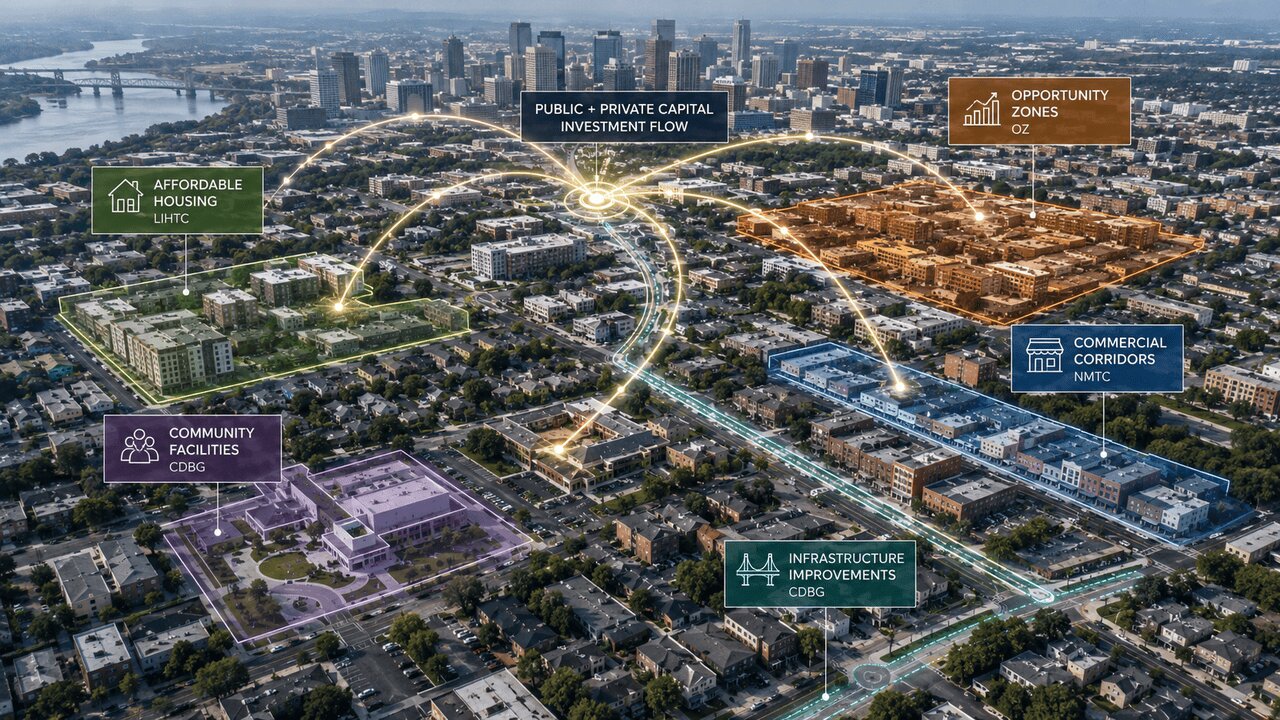
Navigating The Multi-Billion-Dollar Programs That Support Economic Development
On Camber Creek’s Catalyst podcast, Brett Theodos, Director of the Center for Local Finance and Growth at the Urban Institute, explained how community economic development works in the US and gave these programs a grade. His perspective is especially valuable because he studies not just real estate, but the intersection of capital, policy, and place—how money flows into communities, what gets built, and who benefits.
Theodos argues that the United States has created a complex ecosystem of subsidies, tax incentives, and financing programs that collectively direct billions of dollars into neighborhoods every year. Some programs work remarkably well at what they were designed to do. Others reveal deeper structural problems in how the country approaches housing and economic development.
Opportunity Zones
Few programs have generated as much attention in recent years as Opportunity Zones. Theodos explains that the program is optimized for one thing above all else: real estate investment in appreciating markets. Because the biggest tax benefit comes from excluding future capital gains after a 10-year hold period, investors naturally gravitate toward places likely to appreciate significantly.
That reality, he argues, differs from the original rhetoric around Opportunity Zones. Public messaging emphasized job creation and investment in struggling communities. In practice, the structure of the incentive heavily favors real estate projects in markets already positioned for growth. As Theodos put it, “we get out of the policies what we have incentivized to put into them.”
But Opportunity Zones have lower barriers to entry compared to older tax-credit programs. The simplicity of OZs has enabled a broader range of investors and developers to participate.
Low-Income Housing Tax Credits (LIHTC)
The Low-Income Housing Tax Credit remains one of the country’s most important affordable housing tools. According to Theodos, the program is highly effective at producing a specific product: subsidized multifamily housing.
But he also notes that LIHTC is less adaptable than policymakers sometimes assume. Many declining cities already possess substantial housing stock in need of rehabilitation rather than entirely new construction. In those environments, large-box multifamily projects may not align with neighborhood realities.
Theodos argues that America lacks sufficiently flexible tools for smaller-scale rehabilitation and incremental neighborhood redevelopment. The result is a mismatch between available subsidy structures and the actual needs of many communities.
New Markets Tax Credits
The New Markets Tax Credit program supports economic development projects ranging from commercial real estate to community facilities. Theodos believes the program generally succeeds at what it was designed to accomplish, but he highlights a key limitation: scale.
Because of the legal, accounting, and transaction costs involved, New Markets projects often need to be relatively large to justify participation. That creates barriers for smaller developers and smaller communities.
At the same time, he acknowledges that the ecosystem surrounding New Markets—lawyers, accountants, consultants, and mission-oriented intermediaries—has helped sustain bipartisan political support for the program over many years.
Community Development Block Grants
Unlike tax-credit programs, Community Development Block Grant funding gives local governments significant discretion. Cities and counties can use the money for neighborhood revitalization, infrastructure, planning, code enforcement, sidewalks, and housing initiatives.
Theodos sees flexibility as the program’s greatest strength. Local governments often understand local needs better than Washington does.
But he also points out a major challenge: after adjusting for inflation, the program is dramatically smaller than it once was. He notes that the US has steadily shifted away from direct grant spending toward tax-based incentives and expenditures.
The Bigger Challenge
Beyond individual programs, Theodos sees a broader structural issue in American development policy. The country has become good at financing highly subsidized projects in poor neighborhoods and market-rate projects in affluent areas. The space in between is where the system struggles most.
“One hot take, if you will, is that we are decently good at building nice buildings with a lot of subsidy in poor places. We’re also pretty good at building nice buildings without subsidy in affluent or appreciating places. Apart from those market segments, we are not especially good at generating housing in this country or even place-based work more generally.”
For developers, investors, policymakers, and community advocates alike, that insight may be the most important takeaway from the conversation. Real estate development is ultimately about incentives, risk, and time. If the country wants different outcomes, it may need different systems that better reflect the realities developers face on the ground.
Listen to the full conversation on the podcast.