



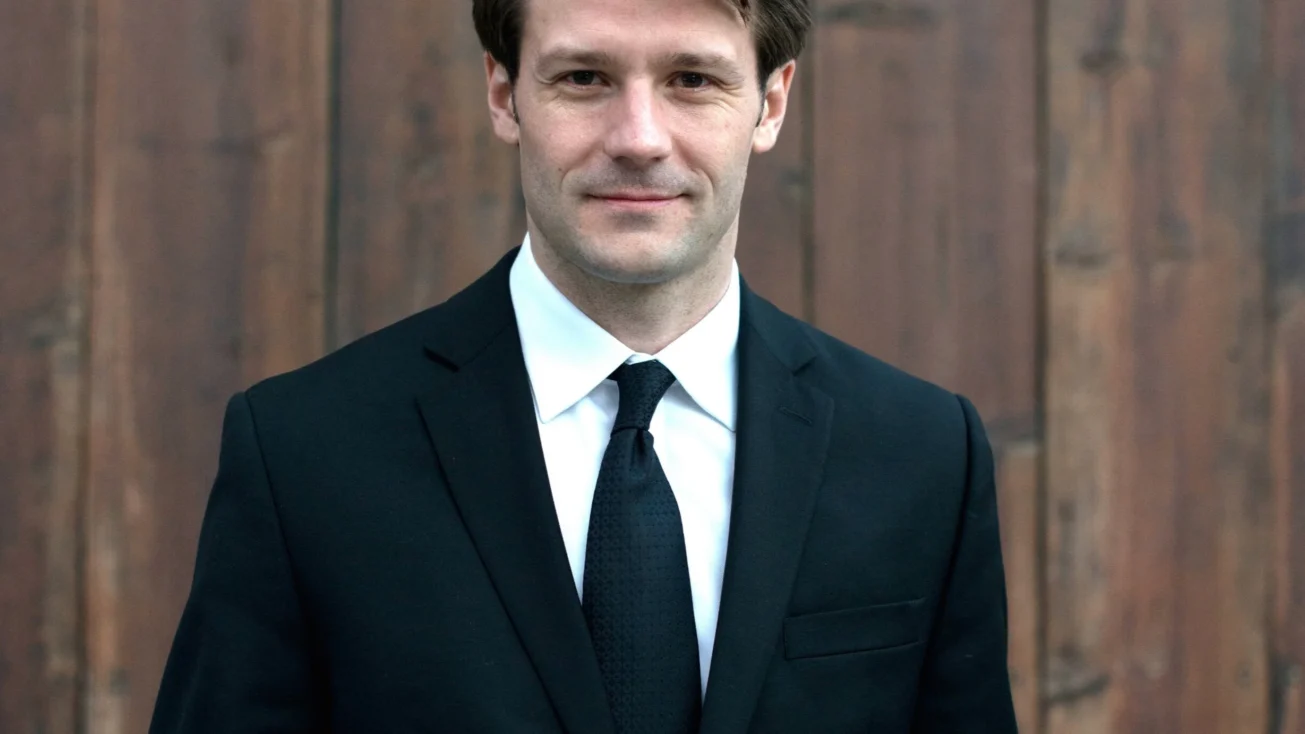
This Grammy-Winning Orchestra Conductor Wants You to Stop Being Afraid of Classical Music
In this episode, we are going to do something extraordinary. We are going to demystify classical music with the help of a Grammy-winning maestro, because Catalyst listeners deserve only the best. James Blachly is an orchestra conductor.
He loves the three Bs: Bach, Beethoven, and Brahms. But he’s winning acclaim for reintroducing the world to outstanding composers whose scores might literally disintegrate if not for the excavation work he and his collaborators perform. And he’s making it okay to dance like a maniac to the Rite of Spring.
Any industry like classical music that is designed to consistently produce peak performance can feel imposing. Excellence requires a great deal of effort. But James reminds us that all that effort isn’t worth anything unless it builds connections between people.
The transcript has been edited for clarity.
Lionel Foster: James, welcome to Catalyst.
James Blachly: Thank you so much. I’m really glad to be here.
Lionel Foster: Folks are going to hear plenty about you—we’ll fill in some of the backstory—but I want to start here. You won a Grammy. What in the world was that like?
James Blachly: It was an incredible experience—surreal for many reasons. It happened during the pandemic, which made it even stranger, because I won a Grammy over Zoom.
We were in a living room—actually my in-laws’ living room—and we heard the announcement there. It’s already a big deal just to be nominated. Normally you’d fly to LA, attend all these events, and celebrate with other nominees. Of course, none of that happened.
So I walked over to the living room carrying a tuxedo in one hand and a box of leftover pizza in the other. I decided that if we lost, I’d eat the pizza, and if we won, I’d put on the tuxedo. We won, so I put on the tuxedo.
Lionel Foster: I’m hoping you wore the tuxedo and ate the pizza.
James Blachly: I don’t remember what happened to the pizza, but it was a genuinely life-changing moment for me, personally and professionally. I definitely wore the tuxedo. And yes, we had a big celebration.
Lionel Foster: Let’s rewind a bit. You’re a maestro—an orchestra conductor. I don’t know if that’s how you introduce yourself at cocktail parties, but when I talk about my friend James, that’s what I say. What does that actually mean?
James Blachly: Let’s start with the word. “Maestro” is Italian and literally means “teacher.” It’s an honorific, similar to “doctor.” My wife does not use that term. Whether colleagues use it really depends on the context.
In some professional settings—especially in opera—it’s standard. In one orchestra I joined, the previous music director insisted on being called “maestro,” and that became the cultural norm. In other contexts, people just use my first name. It varies by orchestra and by situation.
Lionel Foster: You mentioned multiple orchestras. How many groups do you lead?
James Blachly: I currently have two full-time positions. One is in New York City with Experiential Orchestra, which you’ve heard yourself. The other is the Johnstown Symphony Orchestra in western Pennsylvania, near Pittsburgh. I’m in my tenth season in Johnstown, and I’ve been running Experiential Orchestra for about fifteen years.
Lionel Foster: A theme I keep coming back to—and part of why I wanted you on—is that classical music can feel distant or elite. I grew up playing trumpet and was exposed to a lot of classical music, but it can still feel like a different world. And yet, you’re just my friend James. Do people point out that contrast a lot?
James Blachly: I love being that bridge. I love being a conduit into classical music. If I can spend my life inviting people into what I consider one of the greatest human experiences—listening to an orchestra play wonderful music—I’ll be very happy.
Classical music has always existed in tension. Historically, it was music of the elite, but it was also music of the people. That contradiction has always been there.
For me, the orchestra is about unity. No matter where we come from or what our background is, when we’re in the concert hall listening together, something sacred happens. When things are going well, there’s electricity in the room, and everyone feels it.
There are people who treat classical music as something to guard or lord over others—shushing people for clapping between movements, for example. I understand the seriousness behind that, but I don’t want to push people away. I’ve dedicated my career to inviting people in.
Some of the most powerful concerts I’ve conducted were the least constrained—concerts in mills, unconventional spaces, or intimate settings. Thousands of people listening deeply, or sixty people in a room so quiet you can hear a pin drop—both are equally profound.
Lionel Foster: I think classical music’s power has been defanged in the American imagination. But historically, it wasn’t polite or tame at all. The Rite of Spring caused riots.
I remember the first time I heard an orchestra live—the Baltimore Symphony Orchestra. Sitting a few rows back, I realized the concert hall itself is an instrument. The sound pulled me in completely. There were moments where I physically shuddered. It was overwhelming in the best way.
James Blachly: There’s nothing like hearing a great orchestra in a great hall. I compare it to the first time you go to a Major League Baseball game. Everything is bigger, greener, louder. Music is like that—and more.
The sound envelops you. It opens emotions. It can reconnect you with a younger version of yourself or lift you into a sense of spirituality or optimism. It’s a miracle every time.
Lionel Foster: It strikes me that your field is rigorously designed to produce peak experiences over and over again.
James Blachly: That’s exactly right. Every performance carries adrenaline, preparation, and risk. But what we add is the understanding that the impact can be profound.
What I love is knowing that everyone in the hall is having a different experience—and the experience they need to have. A couple married for fifty years will hear the same piece completely differently, even while holding hands.
That combination of communal and individual experience is miraculous. And it’s never the same twice, even with the same orchestra, the same piece, and the same hall.
Lionel Foster: You didn’t grow up in a castle. Tell us about where you came from.
James Blachly: I grew up in 1980s New York City, six blocks from the epicenter of the crack epidemic. At the same time, my family was immersed in music. We attended concerts, my parents performed, and music was always present.
I gave my first public performance at five. At six, I walked onstage at the Metropolitan Opera with American Ballet Theatre. The only instruction was not to look at the audience. Of course, I looked—and I still remember it vividly. I knew I loved performing.
My family struggled financially, but music was our inheritance. My grandfather played cello in the Baltimore Symphony. My father was a conductor. My mother was a music teacher. My stepparents were performers. All four of my parents were musicians.
Without access to music as a child, my life would be completely different.
Lionel Foster: Experiential Orchestra feels like the realization of your philosophy.
James Blachly: It’s a dream machine. We’ve done full-orchestra concerts in New York City apartments, Nutcracker dance-alongs, and Rite of Spring dance parties with hundreds of people jumping together.
The Rite of Spring dance party is probably the wildest thing I’ve ever done—and also one of the most authentic ways to experience that piece. Excellence matters, but so does energy, passion, and inviting the audience fully into the music.
Lionel Foster: Another major part of your work is musical excavation. You won a Grammy for your recording of Dame Ethel Smyth. How did that happen?
James Blachly: I wasn’t always inclusive in how I read music history. I was taught that if a composer wasn’t played at Carnegie Hall, they weren’t great.
In 2014, I encountered Smyth’s work The Prison. I didn’t know if it was good. But the first note told me everything. The orchestration was masterful. The hair on the back of my neck stood up.
I realized I had been wrong my entire career. Smyth was a master composer, and this was a masterpiece. The problem wasn’t her—it was us.
I created a new performing edition from her manuscript, gave US premieres, and recorded the work. The publisher actually discouraged me, saying it wasn’t worth it. That recording went on to win a Grammy.
Her reputation has risen since, and I’m proud to have played a small part in that.
It’s not about fixing history—it’s about paying attention.
I felt the same way about Julia Perry and Coleridge-Taylor Perkinson when I first encountered their work.
Lionel Foster: How does anyone even make it as an orchestra conductor?
James Blachly: It’s extremely competitive. Hundreds apply for a single position. It’s a lifelong dedication.
What I love is that there’s no ceiling. Unlike athletes, conductors get better with age. I watched a 94-year-old conductor do things I know he couldn’t have done ten years earlier.
You do this because you have to. It’s incredibly hard—but deeply rewarding.
Lionel Foster: How did the Grammy change your career?
James Blachly: Completely. It was like getting a Mario Kart star—suddenly everything moved faster. Invitations came from major orchestras in the US and Europe.
But it won’t last forever. What lasts is the work. When an idea is truly right, people feel it. That’s true in music and entrepreneurship alike.
Lionel Foster: That parallel is perfect.
James Blachly: When you hear a sound in your head and know you must make it real, you do whatever it takes. That’s the work.
Lionel Foster: James, thank you.
James Blachly: Thank you. It’s been a joy.